Booth traffic measures how many people walk past, stop at, or enter an exhibit space during a show. It counts arrivals, but it doesn’t necessarily measure what happens next.
Two exhibitors can have identical traffic numbers but completely different outcomes. Prime booth location, exciting brand activations, pre-show marketing, and thoughtful giveaways bring people to your booth. However, the interactive touchpoints inside determine how deeply visitors connect with your team and brand message.
What Trade Show Booth Traffic Actually Measures
Booth traffic only measures arrivals at your booth. It doesn’t tell you how long visitors stayed, what they interacted with, whether they spoke with your team, or if they remember your brand afterward.
Three additional metrics provide the full picture:
- Dwell time: How long the average visitor stays in your booth footprint.
- Participation count: How many visitors actively participated in your booth experience.
- Qualified conversations: How many stops turned into valuable sales leads.
Exhibiting budgets highlight where priorities usually lie. EXHIBITOR magazine’s budget survey of nearly 200 event marketers reveals that booth space accounts for 23% of average spending, exhibit design and construction 16%, promotions 8%, and measurement just 2%. Exhibitors spend four dollars attracting visitors for every dollar spent measuring ROI.
As a result, the metric every exhibitor tracks is often the one their budget helps explain the least.
Why High Foot Traffic Doesn’t Always Equal Lead Generation Results
Booths with the same foot traffic can yield vastly different lead results based on visitor engagement. Han Leenhouts, writing for The Exhibitor Advocate (June 2026), highlights this dynamic: “Companies want to be visible, but sometimes forget that visibility is most effective when paired with meaningful interaction.” He adds, “A trade show booth sets the stage, while interactive elements help initiate smart conversations.”
This gap is changing exhibitor strategies. In the 2026 Event Industry Report by The Exhibitor Advocate and EVOLIO Marketing, 43% of exhibitors said they prefer hosting offsite events over exhibiting at certain trade shows. Joe Federbush, President and Chief Strategist at EVOLIO Marketing, noted that exhibitors are actively “second guessing their approaches to tradeshows and their strategies behind it.”
Promotions like pre-show emails, prime aisle locations, geofencing, and giveaways draw people to your space, but they don’t guarantee engagement. Furthermore, venue regulations limit queue sizes. For example, EXHIBITORLive’s 2025 display rules state that all waiting lines must stay inside the booth footprint, capping display fixtures at 8’3″ and restricting anything over four feet tall to the back five feet of the booth. An overly popular attraction with long lines can quickly cause compliance issues.
Off-booth sessions also increase traffic. Trade Show Executive reported (July 2026) from Freeman’s Unpacking XLNC research that 64% of attendees visited a booth because of an exhibitor’s presentation. While promotion drives attendance, the booth experience itself determines what happens once visitors arrive.
One of our own builds shows the gap between those two numbers. Tekmetric sells shop management software to auto repair shops, and Brick Built Models built them a life-size car out of LEGO® bricks that rolls and steers for the 2026 SEMA Show in Las Vegas.
The booth traffic took care of itself and the booth stayed busy the whole show.
What mattered more is what happened after people walked over. They stayed to ask what Tekmetric actually does, so a car-shaped reason to stop turned into a software conversation. Marketing agencies, attendees and other exhibitors posted the car on LinkedIn without being asked, calling it one of the show’s best booths.
That is what a booth magnet buys you. It earns the arrival, then gives your team something to talk about once the visitor is standing there.
Hands-On vs. Visual Booth Attractions: Creating Multi-Layered Visitor Engagement
When evaluating booth design, event planners often combine visual elements (watching presentations or exploring product displays) with hands-on activities (interactive builds or simulations). Visual displays set the aesthetic tone and communicate brand messaging, while hands-on experiences invite attendees to become co-creators in the space. Both serve distinct purposes, working together to cater to different attendee preferences.
Attendees increasingly seek active participation on the show floor. Freeman research surveying over 2,600 attendees and organizers showed that 61% of attendees define an immersive experience as hands-on interaction, highlighting a valuable opportunity for experiential producers to blend tactile activities into high-impact booth concepts.
Psychological research supports this preference. In the IKEA effect study published in the Journal of Consumer Psychology (2012), researchers Norton, Mochon, and Ariely found that participants valued small LEGO® sets they built themselves twice as high as identical sets built by others. When creations were disassembled, that value gap disappeared ($0.43 vs. $0.29).
Similarly, a 2022 meta-analysis across 145 studies in Psychological Bulletin found a strong memory effect for physical action compared to simply watching someone else perform the action.
While these lab studies focus on individual cognitive tasks, their core insight translates well to event spaces. Building something tangible enhances appreciation, and tactile participation complements visual storytelling to create a more memorable brand interaction.
That said, quick attractions still have their place. Fast-turnaround activities keep lines moving, which works well when your primary goal is scanning a high volume of badges.
Comparing Throughput and Engagement Across Popular Booth Idea Formats
Most attraction vendors publish footprint requirements, but few detail session times or hourly throughput. Where available, published metrics reveal significant differences across formats:
| Format | Attendee engagement | Specs and dimensions |
|---|---|---|
| Money booth | Grabs at flying bills | Over 100 players an hour |
| 360 photo booth | Poses while a camera orbits | Videos around 16 seconds, a 10′ × 10′ space, 8 feet of overhead clearance, two attendants |
| Prize wheel | Spins once | Available in 36″ or 48″ sizes |
| VR station | Plays through a headset | 15–20 guests an hour, 150–200 sq ft once queue and spectators are counted |
| Mobile escape room | Solves a puzzle with a group | About 8 minutes a session, 35–40 participants an hour |
| Collaborative brick mosaic | Builds a section into a shared mural | 2–5 minutes per person per section, 135 sections finished in a 90-minute window |
Money booths offer the highest throughput, accommodating over 100 players per hour with sessions under a minute, ideal for fast badge scanning.
Attractions with longer dwell times process fewer people per hour and require more space for queues and onlookers. For example, CoCo Events NYC notes that while a VR station occupies an 8’x8′ or 10’x10′ footprint, it requires 150 to 200 square feet when accounting for lines and spectators, which is larger than a standard 10’x10′ inline booth space.
By contrast, prize wheel listings often omit spatial and throughput details. National Event Pros lists 36-inch and 48-inch wheel options without mentioning footprint, staff needs, or hourly capacity.
How a Collaborative Brick Mosaic Drives Steady, Predictable Trade Show Floor Engagement
A collaborative brick mosaic operates on section counts that dictate build pacing. Each attendee receives a numbered section, pre-sorted bricks, and an instruction sheet, placing their finished piece onto a growing collective canvas.
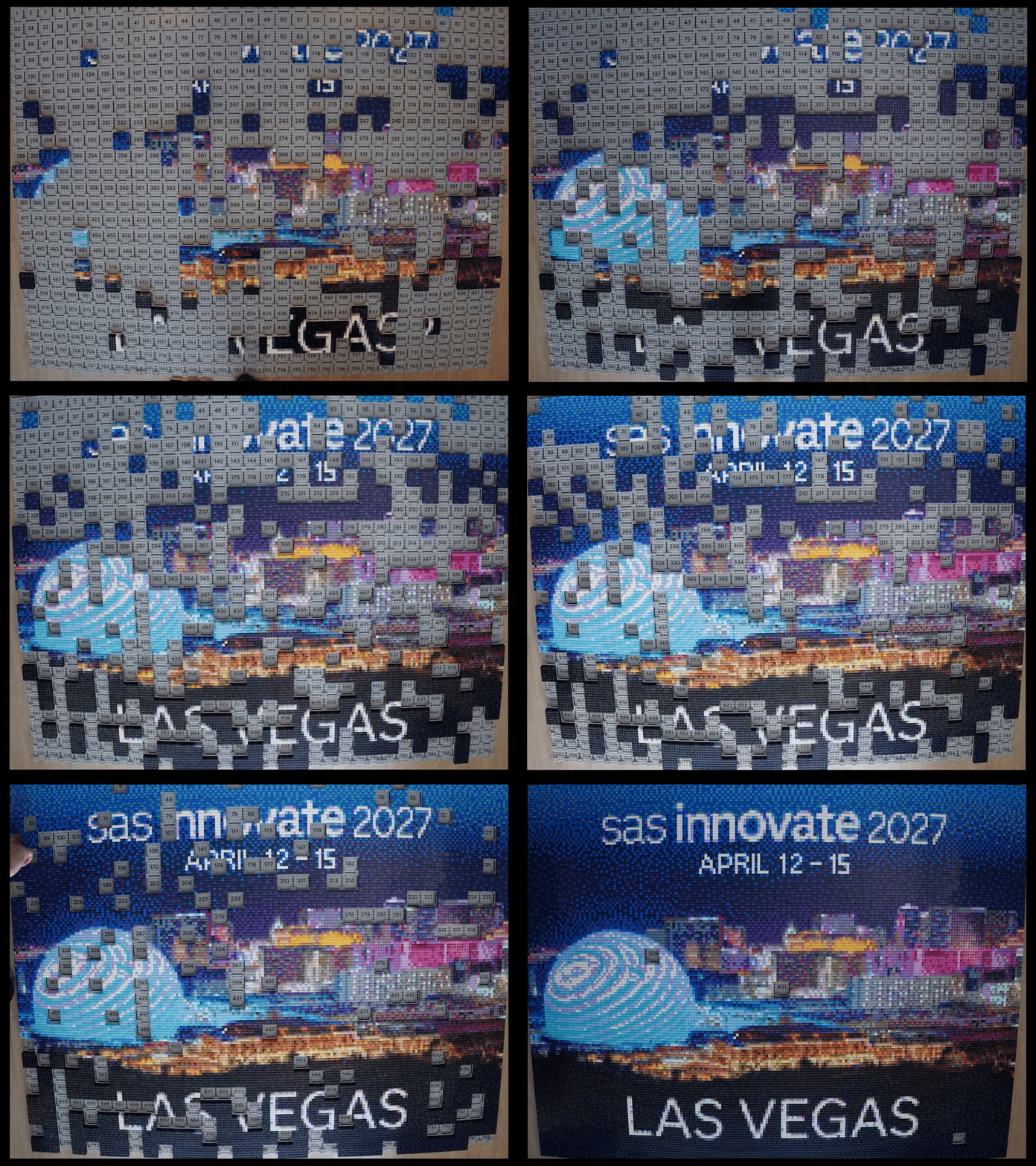
At SAS Innovate 2026, Brick Built Models ran a staged mosaic build featuring 768 sections and over 27,000 LEGO® bricks (5′ x 3.7′). The project averaged 100 sections every two hours across five phases, engaging roughly 400 out of 2,000 total attendees.
This 400-person count reflects active participation across the event, rather than total sales lead volume.
Staging kept engagement steady throughout the show. As SAS noted, staged pacing prevented the display from becoming a quick photo op, encouraging attendees to return to check progress as the final design emerged.
By comparison, Victory of the Lamb’s 90-minute build completed 135 sections on a 75″ x 45″ canvas within a tight time window. Pre-sorted color bins and individual guide sheets ensured smooth participant flow without bottlenecks.
Section counts must be carefully calibrated to audience size. Research shows that sense of accomplishment relies on task completion. A mosaic that remains unfinished at the end of an event loses impact, which is why Brick Built Models sizes the section count and build difficulty to the expected attendance and show hours.
What Interactive Mosaic Activations Involve
A LIVE Brick Mosaics™ activation is a rental that drops into the larger exhibit environments agency partners and exhibit houses design. Brick Built Models designs the mosaic to your brand guidelines, sizes it for audiences from 100 to 100,000, brings it to the show, runs it, and takes it back afterward. It needs about a 10 x 10 ft activation area. Teams that want to keep the finished piece can buy it instead, engineered for the long run.
What the Interactive Station Looks Like on the Show Floor
On the show floor, a mosaic station consists of a table, color-sorted brick bins, individual instruction sheets, and a mounting canvas that fills in as participants build, with our team running it.
Who Manages the Build Activation During the Event
Brick Built Models staffs every activation. Our team is at the table for the whole show, handing out sections, keeping the bins stocked, mounting finished pieces, and adjusting the pace when the aisle gets busy or goes quiet. That is included in the rental rather than quoted as an add-on, so nobody on your side has to learn the build or get pulled off the floor to cover it.
Renting vs. Buying Custom Trade Show Displays
Freeman’s guide on renting vs. owning trade show exhibits suggests renting for 1–2 annual events or overlapping dates, whereas purchasing makes sense for frequent shows with consistent layouts. Activations from Brick Built Models follow the same pattern as most booth elements. They are rentals, custom builds included. Buying is an option for teams that want to keep the piece, and it adds design and engineering work so the build holds up to storage and repeat shipping.
For example, Huber Advanced Materials chose to buy a custom trade show centerpiece from Brick Built Models after weighing their long-term event schedule and budget.
Lead Times and Booking Horizons for Custom Activations
Lead time covers custom design and sizing. UK operator Bricks McGee lists lead times starting at 4 weeks for events with 50–500+ participants, while photo-mosaic provider Picture Mosaics cites a 2–3 week development cycle. Those published floors run two to four weeks. Custom brick builds take longer. Brick Built Models plans for two to three months, and seven weeks is about as tight as a custom build can go. Teams are already booking spring 2027 shows.
Selecting Trade Show Booth Ideas Based on ROI and Reporting Goals
Increasing booth traffic is a key goal, and pairing striking environmental design with engaging hands-on activations ensures attendees stay long enough to build meaningful connections with your team.
For event planners and agencies looking to add 2-to-5-minute collaborative touchpoints to their exhibit designs, a brick mosaic offers a highly participatory solution that enhances the overall attendee journey. Brick Built Models rents brand activations tailored to fit existing floor plans, booth concepts, and show schedules, and our team runs each one on site so yours can focus on the visitors it draws.
Contact us to book a discovery call and plan an activation for your next event.
Frequently Asked Questions About Measuring and Driving Booth Traffic
How Do You Accurately Measure Trade Show Booth Traffic?
Track overall arrivals using badge scanners, door counters, or staff tallies. Combine this count with engagement metrics—dwell time, participation count, and qualified leads—to assess overall ROI.
Should You Rent or Buy a Live Brick Mosaic Activation?
Rent it. Live brick mosaics are rentals, the same as most of what sits in a booth. Brick Built Models designs the mosaic, brings it to the show, runs it, and takes it back afterward. If you want to keep the finished piece, you can buy it instead, engineered for the long run.
How Much Does a Brick Mosaic Booth Activation Cost?
Brick Built Models activations start at $10,000. Pricing runs roughly by the day, and extra days cost less, since most of the cost is the upfront design and build. For comparison, printed photo mosaic rentals run about $2,000 to $8,000 per event.
How Far in Advance Should You Book a Booth Activation?
Plan on two to three months. Seven weeks is the practical floor, and that window covers design rounds, branding sign-off, and section sizing before the event.
Who Operates the Interactive Mosaic Build During the Show?
Brick Built Models runs it. Our team is on site for every activation, keeps the build moving, and adjusts the pace on the floor, so your staff can spend the show talking with the visitors it brings in.
How Many Attendees Can a Collaborative Mosaic Engage?
Activations can scale for events ranging from 100 to over 100,000 attendees. Section counts and build complexity are tailored to match expected foot traffic and show hours.
LEGO® is a trademark of the LEGO Group, which does not sponsor, authorize, or endorse Brick Built Models.