At trade shows, booth engagement is the metric that truly reflects performance.
While aisle traffic shows how many people walk past, engagement tracks what happens when attendees stop. How much time they spend at your booth, the quality of conversations started, and the number of leads captured.
The interactive format you choose directly sets the upper limit for all three.
As Han Leenhouts writes for The Exhibitor Advocate, “Visibility is not the same as results.”
To select a format that fits your event footprint and show date, you need to evaluate five critical factors. Together, these criteria help turn a generic list of booth engagement ideas into a practical, high-performing shortlist.
The 3 Core Metrics for Measuring Trade Show Booth Engagement
Booth engagement focuses on active attendee interest through three standard metrics event marketers report:
- Dwell time
- Conversations started
- Contact records captured
Researchers Srinath Gopalakrishna and Gary Lilien established this structure three decades ago. In a 1995 study published in Marketing Science, they modeled trade show success as a three-stage process: attraction, contact, and conversion.
Their research across 85 exhibiting firms demonstrated that booth size, staff count, and staff training heavily influence each efficiency stage.
Despite these proven stages, many exhibitors focus only on badge scans because they are automated. Dwell time and active conversations often go unmeasured because tracking them requires dedicated observation. In fact, EXHIBITOR Magazine’s budget breakdown reveals that measurement accounts for just 2% of the average trade show budget, slightly less than booth talent.
5 Checklist Questions to Evaluate Any Booth Engagement Idea
To evaluate whether an engagement idea will work within your booth space and event timeline, answer these five key questions:
- Floor Space: How much physical footprint does the activity require, including space for attendee queues?
- Staffing: How many badged team members or dedicated facilitators are needed to run the activation?
- Throughput: How many attendees can participate or complete the experience per hour?
- Booking Runway: How far in advance must you reserve, design, and ship the activation?
- Post-Show Lifecycle: What happens to the setup or takeaways after the show? Do they go home with attendees, return to the vendor, or ship to your office?
Floor space requirements follow strict venue rules. IAEE display guidelines, mirrored publicly by AIHA, define a standard linear booth as 10×10 feet (100 square feet) with maximum display heights capped at 8 feet in the rear portion. Island booths typically begin at 20×20 feet.
Queue lines must also fit within your rented boundary. For example, EXHIBITORLive’s display regulations state that all waiting lines must stay entirely inside the booth footprint. They also require a 3-foot safety setback for demonstrations with moving components or open flames. If an engagement idea draws a crowd, you must budget floor space for the waiting line.
Ultimately, logistics and space constraints determine your maximum engagement potential long before the show floor opens.
Comparing 5 Popular Booth Engagement Formats and Operational Needs
Most trade show engagement ideas fall into five main categories, ranging from quick product demos to fully immersive booth activations. Operational metrics for these categories come directly from equipment manufacturers and event vendors. Because industry-wide benchmarks do not exist, treat hourly throughput metrics as vendor-specific estimates.
Hands-on activities are key to capturing attendee attention. Han Leenhouts notes that attendees often walk past exhibits, glance at products, read signage, and decide within seconds whether to stop. Formats that give attendees an active task earn minutes of dwell time, whereas passive observation formats capture only seconds.
1. Interactive Product Demos
Attendees strongly prefer direct interaction with products. Freeman’s Unpacking XLNC report, conducted with IMEX across 2,600+ attendees and planners, revealed that 61% of attendees prioritize hands-on product experiences above other booth attractions.
Since demo units are often proprietary, space is the primary constraint. A demo catering to five spectators requires sufficient standing room plus safety setbacks for moving equipment. Larger simulators require substantial footprints: Trackman recommends at least 15 feet of width and 10-foot ceilings for golf simulators, while Simulator Consultants requires an 18×20 foot area.
2. Booth Games, Contests, and Prize Wheels
Prize games offer high throughput on minimal floor space. UK vendor Fun & Games Event Hire reports that a standard prize wheel needs just 1 square meter (around 3.3 square feet) of space, handling up to 50 participants per hour without electricity. Similarly, their tabletop Plinko game uses 1 square meter to serve up to 120 players per hour.
Purchasing custom game equipment adds freight costs and lead time. Spinning Designs quotes 9 business days to produce 36- to 60-inch prize wheels and up to 20 days for 96-inch units after design approval. Digital touchscreen games eliminate shipping altogether; Brand Gaming offers screen-ready software starting at $430 per event.
3. Photo Booths and Personalization Stations
Personalization stations exchange floor space and staffing for physical or digital takeaways. Large photo setups carry significant space demands: Extraordinary specifies a full 10×10 foot area for standard 360 video booths (12×12 feet for XL models), along with 8 feet of vertical clearance and two dedicated attendants.
Throughput rates vary significantly across personalization formats. Phototek NYC reports capturing 100+ AI headshots per hour with one queue manager, compared to 20–30 headshots per hour with traditional photographers. Live artists operate at lower volumes: Goofy Faces completes 10 to 15 black-and-white caricatures per hour, and roughly half that in color.
Digital media delivery is instant. Extraordinary delivers 360 videos via SMS, email, or QR code, while Phototek provides attendees with both high-resolution images and 800×800 LinkedIn-ready files.
Physical takeaways provide strong long-term brand recall. Foto Master recommends a 13×5 foot footprint for its photo mosaic wall, noting rental rates of $500–$1,250 per hour. Research from PPAI shows that nearly 90% of US consumers retain branded merchandise for extended periods.
4. Booth Lounges, Seating, and Hospitality Stations
Hospitality setups keep attendees at your booth longer than almost any other option. Coffee carts offer predictable staffing-to-output ratios: Cleveland Espresso estimates 40 drinks per hour for a single barista, 60–80 for two baristas, and 110–160+ for teams of three or four. By contrast, chair massage requires minimal space—about 5×5 feet per chair—and needs no electrical power.
For larger booth builds and lounge structures, exhibit house timelines are critical. Classic Exhibits suggests booking custom rental booths 12 to 16 weeks in advance, with rush options requiring 8 to 10 days.
5. LEGO® Brick Builds and Mosaic Walls
A large brick build works as a booth magnet. Brick Built Models built a life-size LEGO® brick car for Tekmetric that was unveiled at their booth at the 2026 SEMA Show in Las Vegas.
Attendees and other brands made their own content about the car without being asked, and marketing agencies posted on LinkedIn calling it one of the best booths at the show. Many visitors came to see the car and then asked what Tekmetric does. For a software company, the build made an abstract product physical and gave people a reason to stop. Brick Built Models’ team ran it on site, so Tekmetric’s own staff could spend the show talking with the prospects it pulled in.
Mosaic builds work differently: participatory brick builds turn passersby into active collaborators at scale.
Live mosaic builds let dozens of participants assemble sections at the same time, and the shared branded piece fills in over the show.
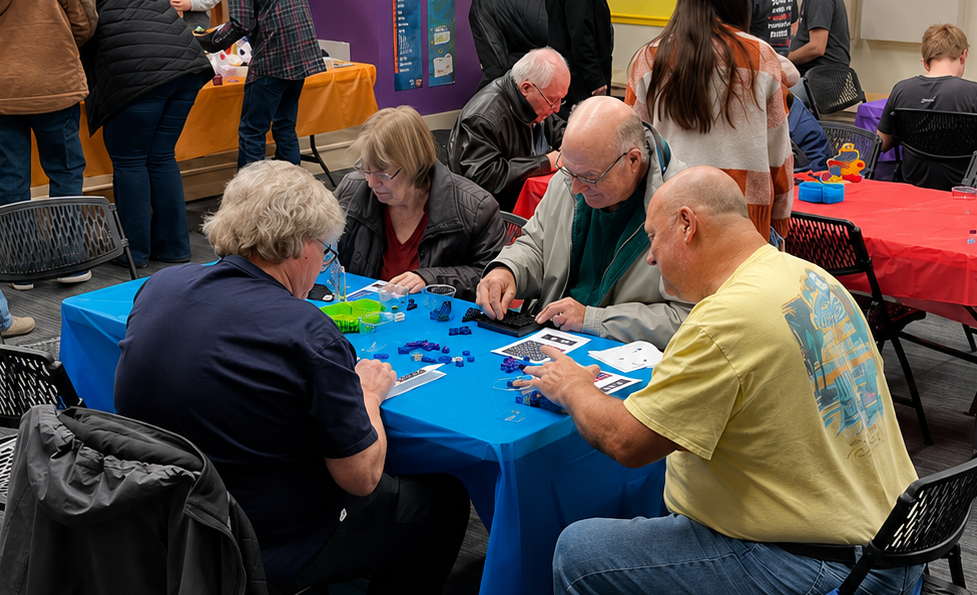
At a campaign event for Victory of the Lamb, participants completed a 75×45 inch mosaic canvas split into 135 individual sections. With each section taking 2–5 minutes, attendees finished the entire artwork in 90 minutes using pre-sorted bins and printed instructions.
At a larger scale, Brick Built Models designed a custom wall for SAS Innovate 2026.
The 5×3.7-foot mosaic comprised 768 sections and 27,000+ LEGO® bricks. Operating at roughly 100 sections every two hours, the activation engaged ~400 of the 2,000 attendees in building a shared, high-impact display piece.
Plan for about a 10 x 10 ft activation area for live mosaic builds, with room for the build tables and the people around them. Brick Built Models’ team runs every activation on site, which frees your own staff to talk with the visitors it draws. Book two to three months ahead; about seven weeks is the realistic minimum for custom work.
LIVE Brick Mosaics generate participation at scale that drives every secondary benefit:
- Peak photo moments
- Organic foot traffic
- Extended booth visibility
This booth engagement naturally emerges as hundreds of contributors stop to admire and share their collective achievement.
Best Practices for Capturing and Qualifying Trade Show Leads
Badge scanning is seamless because attendees consent during event registration. For example, terms for the 2026 National Restaurant Association Show specify that guests agree to share personal data with exhibitors when scanning badges via lead retrieval systems.
Lead retrieval equipment carries fixed costs. Maritz quotes mobile app licenses for the Restaurant Show at $579 (early) or $599 (standard), matching hardware scanner rental fees. For the 2027 AAOS Annual Meeting, Maritz SWAP app access ranges from $470 to $540, with custom qualifiers priced at $155.
Adding survey qualifiers is essential for lead scoring. As Han Leenhouts warns, “If everything is a lead, eventually nothing is a lead.” Asking 2–3 qualifier questions during interactions helps distinguish casual visitors from qualified prospects.
Timely follow-up is equally critical. Maritz notes that lead data captured manually or via badge photos must be uploaded within 14 days post-show and incurs processing fees. Delaying data entry increases costs and degrades lead quality.
4 Common Booth Engagement Mistakes That Lower Trade Show ROI
The most costly event mistakes occur during planning. Freeman’s Unpacking XLNC study revealed that while 78% of organizers believe they deliver peak experiences, only 40% of attendees agree. Additional research reported by Trade Show Executive showed 81% of exhibitors focus on take-home value, yet only 61% of attendees find those takeaways valuable.
Sales targets often miss the mark as well.
UFI and Explori’s Global Exhibitor Insights study indicated that over half of exhibitors failed to meet sales goals, resulting in an industry-wide Net Promoter Score of -17.
To protect your ROI, avoid these four common booth engagement mistakes:
- Late Booking: Booking less than 12 weeks out limits your choices to off-the-shelf, fast-shipping items.
- Ignoring Space Requirements: Failing to measure queue lines, safety setbacks, or ceiling heights leads to venue compliance issues.
- Equating Scans with Engagement: A quick badge scan confirms attendance, but does not guarantee meaningful interest.
- Choosing Low-Capacity Formats: Slow-moving activities build excessive waiting lines that turn attendees away.
Each event is a strategic investment that requires a mix of upfront planning and clear followup to maximize the ROI of attendance and exhibiting.
Calculating the Real Cost of 10×10 and 20×20 Trade Show Booths
Renting floor space is only the beginning of booth costs. Published rates for upcoming shows illustrate baseline expenses: AISTech 2027 charges $34.00 per square foot ($3,400 for a 10×10), while the Florida Restaurant Show quotes $39.95 per square foot while explicitly noting that carpet, furniture, electricity, and decorations carry separate fees.
Ancillary costs continue to rise.
According to The Exhibitor Advocate’s 2025 rate survey, material handling (drayage) averages $2.28 per pound, a 21.3% increase since 2022, while electrical utility rates rose 18.4% in 2025 alone.
Your booth footprint dictates layout options more than budget. Inside a 10×10 space, compact activations like prize wheels or sketch artists preserve room for conversations, whereas a 360 booth consumes the whole footprint.
A 20×20 island booth, however, can comfortably combine a build wall, a demo station, and a seating area.
Activation pricing varies by scale. Brick Built Models offers brand activations as rentals, like most booth elements, starting at $10,000. Pricing runs roughly by the day. Custom sets are priced separately and can cost less.
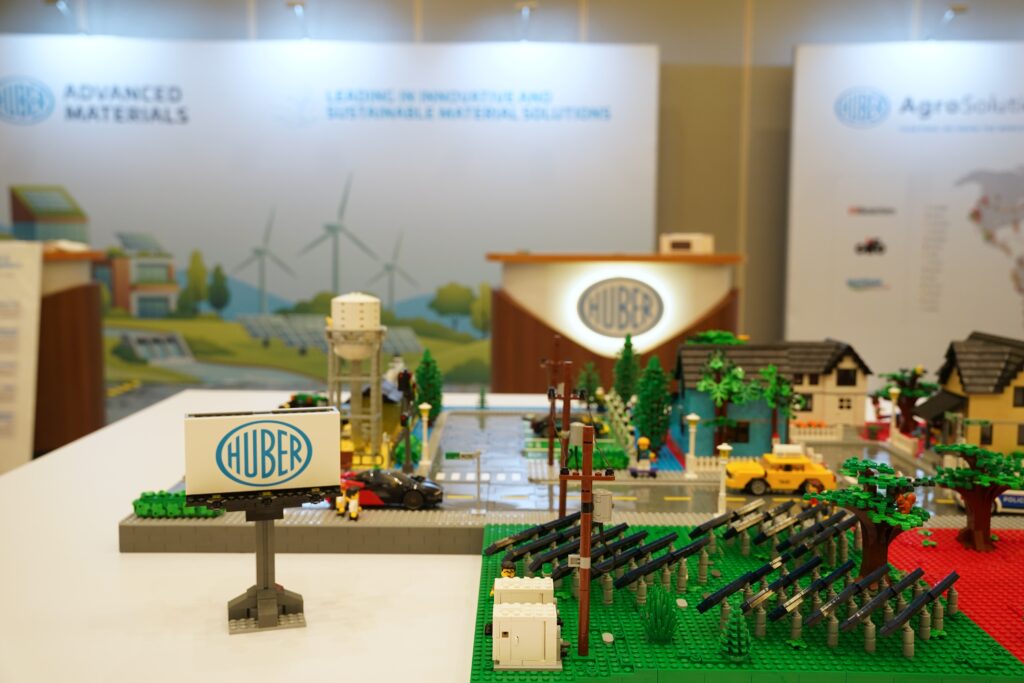
Buying the piece is also an option. When Huber Advanced Materials chose to own a custom LEGO® city display to reuse across multiple events, modular design and reusable heavy-duty crates were added as part of the project.
How to Plan and Scope a Custom Booth Activation
Properly planning an activation requires three key details: your show date, booth footprint, and expected attendee volume.
Sharing these details allows Brick Built Models to recommend dimensions for your activation area, estimate hourly throughput, and quote the rental, along with the purchase price if you want to keep the piece.
Start two to three months before the show. About seven weeks is the realistic minimum for custom work, and teams are already planning their spring 2027 shows.
Frequently Asked Questions About Trade Show Booth Engagement
What is booth engagement?
Booth engagement measures how effectively an exhibit converts foot traffic into active interactions, evaluated by dwell time, meaningful conversations, and captured leads. Unlike traffic count, which tracks all passersby, the 1995 Gopalakrishna and Lilien Marketing Science study defines engagement across three distinct stages: attraction, contact, and conversion.
What booth engagement ideas work best in a 10×10 booth?
Ideal 10×10 booth engagement ideas fit both the activity and queue within 100 square feet. Recommended formats include prize wheels (~3.3 sq ft), seated massage chairs (~5×5 ft per chair), or live sketch stations. By contrast, a 360 video booth consumes the entire 10×10 area.
How much does a booth activation cost?
Activation pricing is separate from floor space rental ($34.00–$39.95/sq ft based on recent event data). Brick Built Models activations are rentals that start at $10,000, priced roughly by the day, with extra days costing less.
How far in advance should I book a booth activation?
Book custom activations two to three months ahead. Classic Exhibits recommends reserving rental exhibits 12 to 16 weeks ahead. For a custom brick build from Brick Built Models, about seven weeks is the realistic minimum.
LEGO® is a trademark of the LEGO Group, which does not sponsor, authorize, or endorse Brick Built Models.