
The best trade show booth games achieve three key goals: they drive steady foot traffic, hold attention long enough for quality conversations, and remain portable enough to avoid consuming your event budget with freight costs.
We evaluated ten popular game formats using three primary metrics and one key tiebreaker:
- Throughput (people per hour): How many attendees can participate throughout the event.
- Engagement time: Whether participants stay engaged long enough for your team to start a conversation.
- Spatial footprint: The physical floor space and height required, including space for waiting lines.
- Freight costs: The ongoing expense of transporting equipment to and from shows.
Evaluating these factors will help you select the ideal attraction to entertain guests, build relationships, and drive conversions.
Top Trade Show Booth Games and Activities at a Glance
# |
Format |
Rent or own |
Floor space published |
People per hour published |
|---|---|---|---|---|
1 |
LIVE LEGO® brick mosaic builds |
Rental or purchase |
Canvas ~45 × 60 in, floor footprint not published |
90 sections/hr; ~400 of ~2,000 attendees (Brick Built Models) |
2 |
Money booth (cash cube) |
Rental |
5 × 9 ft |
Over 100 players/hr (Money Machine Cash Cube) |
3 |
Live headshot station |
Rental |
8 × 8 ft staffed |
100+/hr in AI mode (Phototek NYC) |
4 |
Reaction-speed wall |
Rental |
2.6 × 2 m operating area |
Up to 60/hr (Big Fun) |
5 |
Branded game on a booth screen |
Rental |
A screen |
Not published |
6 |
Cotton candy machine |
Purchase |
29 × 31 in machine |
6–7 servings/min (Gold Medal Products) |
7 |
Floor-standing prize wheel |
Purchase |
48 × 30 in cabinet (Arcade Party Rental) |
Not published |
8 |
Prize drop or plinko board |
Purchase |
4 × 6 ft board |
Not published anywhere |
9 |
Giant lawn games and putting mats |
Purchase |
30 × 84 in mat |
Not published |
10 |
Statement sculpture or display model |
Purchase |
Varies |
Spectating, not participating |
Our Top 10 Picks for Trade Show Activities
Each of these top options fits within a standard 10×10 inline booth with room for attendee queues. Because they are available as rentals, you can ship them back after the event rather than paying recurring transport fees.
1. Collaborative Brick Mosaic Build Wall
With a collaborative brick mosaic wall, attendees follow an instruction card, select bricks from sorted bins, assemble a small segment, and attach it to a collective canvas that builds out across the show.
During the Victory of the Lamb event, participants assembled 135 segments in 90 minutes, spending 2 to 5 minutes per section. This translates to a throughput of 90 sections per hour from a single station, maintaining smooth flow with no bottlenecks or waiting.
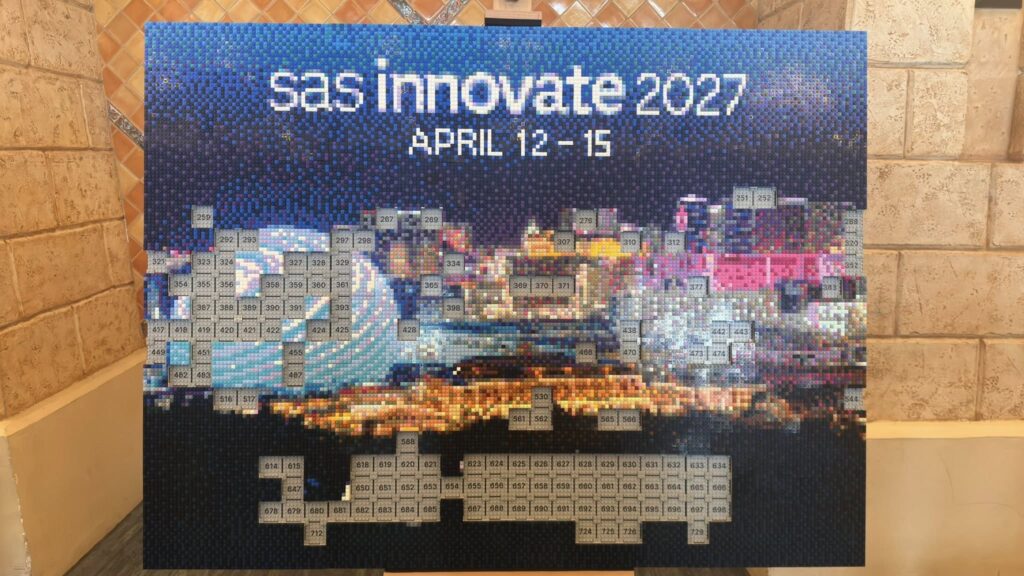
At SAS Innovate 2026, the activation was paced across a multi-day schedule, averaging about 100 sections every two hours for a 768-section mural. Approximately 400 of the 2,000 attendees participated directly.
The extended engagement time makes the build wall exceptionally effective: spending 2 to 5 minutes on an activity provides a natural window for booth staff to initiate conversations.
Brick Built Models can adjust the assembly pace based on expected event duration and attendee volume.
LIVE Brick Mosaics™ feature an average canvas size of 45 by 60 inches, with designs scaled for 100 to 100,000 participants. Setup requires space for the canvas, a build table, and surrounding standing room.
2. Money Booth, Also Sold as a Cash Cube
A money booth (or cash cube) is an inflatable enclosure where participants attempt to catch flying paper currency within a set time limit. Money Machine Cash Cube lists a 5×9-foot footprint for its circular model and advertises capacity for over 100 players per hour. According to their FAQ, individual turns last 20 to 25 seconds, and setup or teardown takes 10 to 15 minutes for one person.
This offers the highest verified hourly throughput among physical game formats on our list.
However, its main limitation is brief participant engagement.
Because players spend only 25 seconds inside, there is minimal opportunity for booth staff to start a meaningful conversation before the participant moves on.
Despite this, it remains an energetic and eye-catching attraction.
3. Live Headshot Station
A headshot station provides professional portraits for attendees on-site. Phototek NYC’s AI mode processes 100+ headshots per hour (compared to 20–30 per hour with a traditional photographer) and delivers digital files in under a minute, with an attendant managing the queue. Physical prints are also fast; the DNP DS620A produces 4×6 photos in under 9 seconds.
The space requirement is compact. Extraordinary specifies an 8×8-foot space (64 sq. ft.) for its staffed Live Photo Station, requiring a 2-hour setup window for a standard rental.
4. Reaction-Speed Wall
A reaction-speed wall tests hand-eye coordination as players hit illuminated targets within a timed round. Big Fun’s Batak Pro unit requires an operational footprint of 2.6m by 2m, a standard 13-amp power outlet, and accommodates up to 60 players per hour. Equation Events similarly estimates 40 to 60 players an hour based on 60-second rounds, making 60 players per hour a practical maximum.
5. A Branded Game Running on a Booth Screen
Digital games run via web URLs on existing booth monitors, eliminating heavy equipment and shipping crates.
Brand Gaming offers event options starting at $430 per event requiring only a standard screen and internet connection. This eliminates freight fees, providing a cost-effective alternative to physical rentals or purchases.
Throughput for screen-based games depends primarily on the number of displays and staff members available.
6. Cotton Candy or Another Concession Machine
Concession machines provide high volume and broad appeal.
The Gold Medal Super Floss machine produces up to 6–7 servings per minute (360+ per hour), measures 29x31x19 inches, and costs $2,525. It occupies roughly six square feet of counter space.
Note that high-draw machines often require dedicated electrical circuits (e.g., 30-amp 120V). While traffic generation is high, individual interactions are brief.
7. Floor-Standing Prize Wheel
Prize wheels offer simple, familiar gameplay: participants spin to win branded giveaways.
National Event Pros offers 36-inch and 48-inch models.
Arcade Party Rental provides a 48-inch model (48″ wide, 30″ deep, 90″ tall) weighing 150 lbs.
Prize wheels occupy minimal floor space (around 10 sq. ft.), but because turns are sequential, total hourly capacity is relatively low.
8. Prize Drop or Plinko Board
Drop boards involve dropping a puck down a pegged board into designated prize slots.
Entry-level models from 4imprint start at $455, while larger options like Prize Wheel Depot’s 4×6-foot Drop & Win board run $2,549.
The standard 4imprint Prize Drop stands 50.5 inches high by 32 inches wide, folds down to 2 inches deep, and weighs 12.5 lbs.
When calculating logistics, remember to account for protective cases and shipping crates, which can significantly increase total freight weight relative to the game itself.
9. Giant Lawn Games and Custom Putting Mats
Lawn games offer a low-cost entry point. LookOurWay’s branded mini-golf set includes a 30×84-inch mat for $159.95, weighing 8–10 lbs with minimal setup required.
However, spatial requirements can be significant.
An 84-inch mat uses 7 feet of depth in a 10-foot booth. Vertical games like Yard Games’ tumbling timbers reach up to 5 feet during play, which must adhere to exhibit height limits when placed on tables.
While lawn games foster relaxed engagement, throughput is naturally limited by game length and participant capacity.
10. Statement Sculpture or Large Display Model
Huber Advanced Materials featured a custom 3’9″ x 3’9″ LEGO® city display alongside bulk building bricks to create an interactive centerpiece.
This setup served as both a visual brand anchor and a hands-on activity station.
Purchasing a permanent display requires durable construction and custom crating for safe transport across multiple events, which impacts long-term freight calculations.
Booth Game Space Requirements and Trade Show Display Rules
Understanding event facility regulations is essential when planning booth activities.
Standard linear booths provide 100 square feet (10×10 ft). Guidelines like the EXHIBITORLive display rules set a height cap of 8 feet 3 inches, restrict items over 4 feet tall to the rear half of the booth, prohibit hanging signs in linear spaces, and enforce noise limits (typically 85 decibels at the aisle).
Crucially, all participant queues must fit entirely within your booth boundaries.
Overcrowding into aisles can violate event safety regulations.
For instance, CoCo Events NYC notes that a single VR station requires an 8×8 to 10×10-foot footprint, recommending 150–200 sq. ft. total for queuing and viewing, while accommodating only 15–20 guests per hour. This space requirement exceeds a standard linear booth footprint.
Several other popular attractions face similar space or logistical limits in standard booths:
- Golf simulators: Simulator Consultants’ rentals require a minimum space of 18′ W x 10’6″ H x 20′ D, plus 4–5 hours setup time.
- Skee-Ball alleys: Bay Tek’s Skee-Ball Classic requires a depth of 10 feet 3 inches and a height of 10 feet 8 inches, exceeding basic linear booth dimensions.
- Axe throwing: World Axe Throwing League guidelines mandate a 12-foot ceiling and a 12×15-foot minimum lane.
- Regulation cornhole: ACL regulations place boards 27 feet apart, requiring roughly 35 feet of linear space.
Drayage, Freight Costs, Crating Fees, Oh My!
Transporting and handling equipment (drayage) represents a major component of event budgets.
Drayage is billed per hundredweight (CWT) for round-trip service, rounded up to the nearest 100 lbs. Most contractors enforce a minimum charge of 2 to 3 CWT per shipment, with surcharges for uncrated or specialized handling.
For example, shipping a 120-lb prize wheel (billed at the 2 CWT minimum) across six sample 2026 shows incurs variable drayage fees:
- National College Fair Houston: $90.84/CWT ($181.68 total)
- WEST 2026 San Diego: $165.50/CWT ($331.00 total)
- AFCEA TechNet Cyber Baltimore: $194.25/CWT ($388.50 total)
- SAEM26 Atlanta, Viper, $232.70 per CWT = $465.40
- ASGCT Boston: $323.95/CWT ($647.90 total)
- APPA Chicago, Viper, $461.60 per CWT = $923.20
Because minimum thresholds apply, lightweight items shipped separately incur the same baseline CWT fee as heavier single crates.
Four more published specifics worth carrying into a budget:
- Crating requirements: Uncrated freight often carries substantial surcharges (e.g., up to 40% higher rates). Fern Expo notes billed weight includes pallets and packaging.
- Variable minimums: Contractors like GES may set minimums at 300 lbs.
- Per-pound pricing: Some shows (e.g., IAAPA Expo) bill directly per pound (e.g., $0.82/lb).
- Rising rates: According to The Exhibitor Advocate, material handling rates averaged $2.28 per pound in 2025, reflecting continued upward trends.
As Freeman’s rent-vs-own guidance suggests, renting is typically ideal for 1–2 annual events, while purchasing becomes economical at 3 or more shows with consistent booth layouts.
How a Rented Brick Mosaic Build Wall Runs at a Real Show
A LIVE Brick Mosaic™ rental provides a complete turn-key activation solution.
Attendees build the mural during the event, creating a finished backdrop for photos. Afterward, the kit is returned, avoiding recurring storage, maintenance, and drayage fees unless you choose to purchase the final artwork.
The interactive flow naturally encourages engagement and conversation.
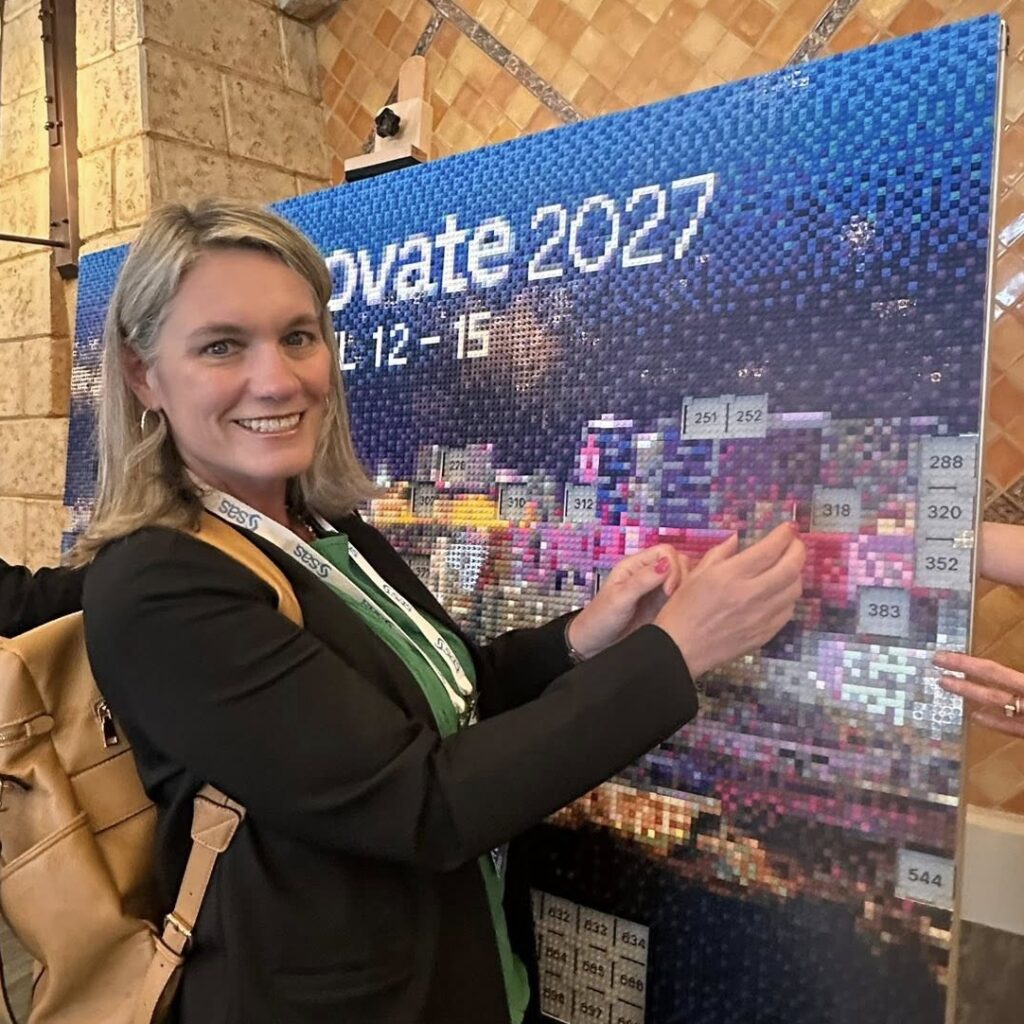
Participants pick up instruction cards, select bricks from color-sorted bins, build their segments, and place them on the wall. The process maintains a steady flow without equipment delays, providing 2 to 5 minutes of focused engagement per person.
Repeat participation is common, with attendees returning throughout the show to complete additional sections.
Research from Freeman’s Unpacking XLNC survey of over 3,300 attendees and exhibitors indicates that 75% of attendees learn best through hands-on activities and demonstrations.
Kits can be professionally staffed or provided as self-run rentals complete with instructions, pre-sorted bins, and remote support.
How to Choose a Trade Show Booth Game or Activity for Your Next Event
Selecting the right booth activity involves balancing three factors:
The game must fit within your designated booth footprint, hold participant attention long enough for meaningful interaction, and align with your event budget.
Collaborative build walls meet all three criteria by turning attendees into active participants who co-create your booth display.
Plan Your Next Trade Show Booth Activity
Contact our team to explore custom mosaics, statement builds, and brand activations for your upcoming events.
Frequently Asked Questions About Trade Show Booth Games
How much space does a trade show booth game need in a 10×10 booth?
A trade show booth game needs 10 to 64 square feet of a 10×10 booth, plus room for its queue. The EXHIBITORLive display regulations require any queue formed for exhibitor customer interaction to be contained within the booth footprint. Published footprints for booth-scale formats run from 10 square feet for a prize wheel cabinet to 25 for a chair massage station, 45 for a money booth, and 64 for a staffed photo station. A VR station is the clearest failure case at 150 to 200 square feet of planning area per CoCo Events NYC, inside a booth that only has 100.
How many attendees can a booth game serve per hour?
A booth game serves anywhere from about 15 to over 100 attendees an hour, and most vendors don’t publish the number. Published figures include 15 to 20 an hour for a VR station, up to 60 for a reaction-speed wall, 90 sections an hour for a brick mosaic build wall, and over 100 players an hour for a money booth. No publisher prints one for a prize wheel. Across 34 products from 15 publishers, throughput was published four times, so treat a vendor who volunteers it as unusual and one who won’t as a question to press.
Is it cheaper to rent or buy a trade show booth attraction?
Renting a trade show booth attraction is cheaper if you exhibit at one or two shows a year, and buying is cheaper at three or more shows with similar configurations. That’s Freeman’s published guidance, and it matches how the costs behave. A purchase pays once for the object and then pays drayage, storage, and repair at every show for as long as it exists, while a rental’s cost ends at teardown.
What does it cost to ship a booth game to a trade show?
Shipping a booth game to a trade show costs $180 to $925 round trip for anything under 200 pounds, depending on the city. Six general service contractors published 2026 advance-warehouse crated rates from $90.84 per CWT at National College Fair Houston to $461.60 per CWT at the APPA Institute in Chicago, and the 200-pound minimum most of them apply means a 6-pound game and a 199-pound game bill identically. The line we see missed most often is that minimum, because a small game shipped separately from the booth freight pays it on its own.
Do conference booth activity ideas follow the same rules as trade show ones?
Yes, conference booth activity ideas follow the same rules as trade show booth games, and the constraints are usually tighter. A conference booth sits under the same display regulations, drayage rate card, and electrical order form, and conference programming pulls attendees off the floor in blocks. The block scheduling makes capacity per hour matter more, because traffic comes in waves when sessions let out.
LEGO® is a trademark of the LEGO Group, which does not sponsor, authorize, or endorse Brick Built Models.