
We all love a good interactive trade show booth.
Something where you actually get to do something fun or interesting instead of just hearing a pitch or watching a demo or signing up for a mailing list.
But the novelty of the idea or activity is only part of the consideration.
There’s also the logistics, the data, and the realities of running the booth itself:
- Throughput per hour
- Staff numbers and time required
- Rental or purchase economics
- Production lead time
- What you keep after the teardown
Those five numbers decide whether an attraction works in a 10-by-10 inline booth staffed by two people at a show that opens at nine, and whether that cool idea will actually fit within your timeline, budget, and available resources.
13 Interactive Trade Show Ideas (Quick Look)
These are some of the most popular formats and ideas for generating trade show buzz and driving engagement at your brand’s booth.
| Format | People per hour | Staffing requirements | Rent or own | Published lead time | Left after teardown |
|---|---|---|---|---|---|
| 360 photo booth | 16-sec capture; rate not published | 2 attendants, vendor-supplied | Rent | Not published | Video files |
| AI headshot station | 100+ in AI mode | 1 attendant, vendor-supplied | Rent | Not published | Digital files |
| Instant-print photo wall | ~40 per camera on 90-sec film | 1, yours | Buy consumables | Off the shelf | The print |
| Photo mosaic wall | Variable | Optional | Rent | 2–3 weeks | Image file |
| Collaborative brick build wall | ~50–90 sections/hr in published builds | 0 vendor staff if self-run | Rent or purchase | Scoped in discovery | The completed mosaic (if purchased) |
| Live screen printing | 60–75 per press | 2–4 operators, vendor-supplied | Booked service | Not published | The shirt |
| Espresso cart | 40 per barista | 1 barista per 50 guests | Booked service | Not published | Nothing |
| Caricature artist | 10–15 black-and-white | 1 artist per station | Booked service | Not published | The drawing |
| Custom prize wheel | Variable | 1, yours | Buy | 7–20 business days | The wheel, ~120 lbs |
| Rented arcade game | 50–120, by game | Optional; count not published | Rent | Not published | The prize |
| Golf or racing simulator | Variable | 1 attendant | Rent | Not published | Nothing |
| Hologram or VR station | Variable | Not published | Rent | Not published | Nothing |
| Centerpiece model with build stations | Variable | 0 to keep them running | Buy or rent | Not published | The model (if purchased) |
Each row reports one named vendor's own published terms for that format.
1. 360 Photo Booth
Attendees stand on a small platform while a camera arm circles them, and the payoff is a slow-motion video that looks professionally shot. A 360 photo booth needs all 100 square feet of a standard inline space. Extraordinary, a photo-booth rental company, publishes a standard footprint of 10ft by 10ft, 12ft by 12ft for the XL unit, and "at least 8 feet of clearance above the booth."
Two dedicated attendants come with the Extraordinary rental, and the booth goes back with them. Setup runs about an hour inside a two-hour window, each capture is roughly 16 seconds, and bookings run from two hours to multi-day. The attendee keeps a video.
2. AI Headshot Station
Attendees pose for one quick photo and get back a polished professional headshot, a giveaway almost everyone on a show floor actually wants. Phototek NYC, a New York photo-booth rental company, publishes 100+ headshots per hour in AI mode against 20 to 30 per hour with a photographer, and under 60 seconds per guest.
Staffing is one on-site attendant in AI mode, and the rental covers it. Traditional mode adds a photographer, and throughput falls by roughly three quarters. The attendee walks away with a file. Gate delivery behind an email address and that address is what the booth keeps.
3. Instant-Print Photo Wall
Attendees pose for a photo and watch the print develop in their hands a minute later. Instant-print stations run at the speed of the film.
Fujifilm's instax mini specification lists a developing time of "Approx. 90 seconds (varies depending on the ambient temperature)," with film shipping ten exposures to a pack.
So that means one camera turning out a print every 90 seconds tops out near 40 prints an hour, which is four packs, and a six-hour show day at that pace burns roughly 24 packs. One of your own people works the camera all day, you buy film rather than renting hardware, and the print goes home with each visitor.
4. Collaborative Brick Build Mosaic
Every visitor builds one small piece of a big picture, and the crowd finishes the artwork together. A collaborative brick build wall gives each attendee a numbered section, a small set of LEGO® bricks, and an instruction sheet. They build the section in a couple of minutes, place it on the board, and a branded image fills in across the day.
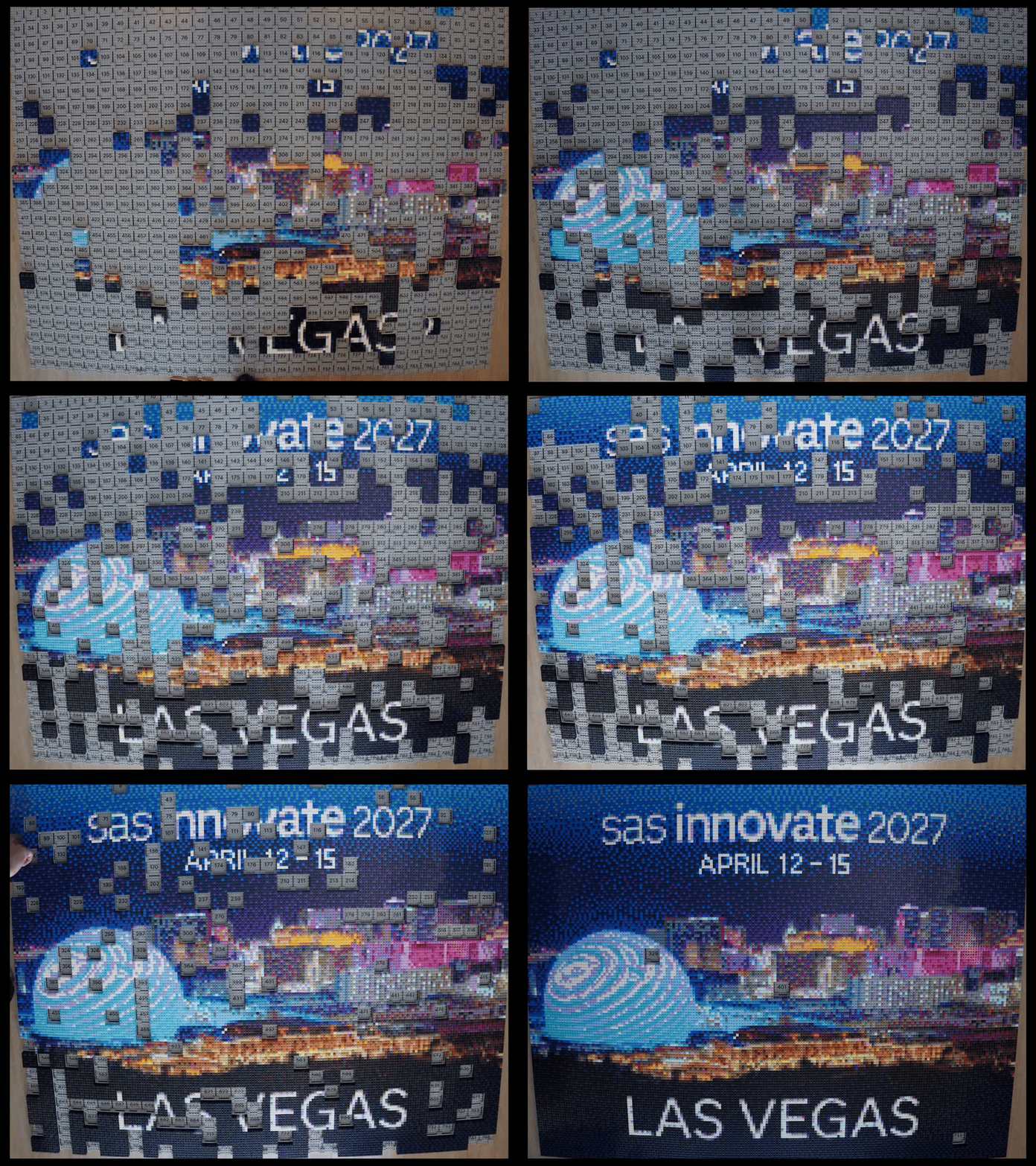
Brick Built Models is a brand experience company that builds LIVE Brick Mosaics™ for trade shows, conferences, and company events.
At a staged conference build for SAS Innovate 2026, the activation completed roughly 100 sections every two hours across a 768-section, 27,000-brick build, and about 400 of the conference's roughly 2,000 attendees took part.
At an unstaffed mosaic build for Victory of the Lamb, guests finished 135 sections inside a 90-minute window at two to five minutes per person. Divide those out and the SAS build ran about 50 sections an hour, the Victory of the Lamb built about 90.
SAS staff ran their own build using a master manual and remote support. Victory of the Lamb ran unstaffed, with bricks pre-sorted by color into labeled bins, individual instruction sheets for participants, and 24/7 remote support through setup and the event.
Most mosaic engagements are rentals. The SAS kit shipped to the client, traveled to the event, and came back to the studio afterward. A Brick Built Models technician wall-mounted the Victory of the Lamb mosaic in the church lobby after that event ended. Clients decide whether to purchase the finished piece and keep it.
5. Photo Mosaic Wall
Attendees add their photo, then come back later to find their own tile in the finished image. A photo mosaic wall assembles a single large image from individual attendee photos as the event runs. Foto Master, which manufactures one, recommends a minimum setup space of 13 x 5 feet and says the unit takes minutes to assemble.
Foto Master also publishes what its customers charge, reporting an average of $500-$1,250 per hour, with typical event rates ranging from $2,000 to $8,000.
Picture Mosaics, a live-event mosaic vendor, publishes a two-to-three week development cycle before an event and says staffing "may or may not be required" depending on the services selected. On price, the same FAQ says only that "pricing may vary" and points buyers to a custom quote. The wall is generally rented and the finished image only survives as a file or a photo rather than an object.
6. Live Screen Printing
Watching your own shirt get printed is a show in itself, and the press pulls a crowd on its own. Live screen printing prints a shirt or tote on the floor while the attendee waits. Danger.Live, an on-site event printing company, publishes 60 to 75 prints per hour per press, roughly 45 to 60 seconds per piece on a single screen press, and 75 to 300 per hour across a larger multi-station setup.
The footprint is the constraint most exhibitors miss. Danger.Live publishes 10ft by 15ft for a single-press setup and 15ft by 15ft for two presses, so one press already exceeds the 100 square feet of a standard inline booth. Power is one dedicated 20-amp circuit per screen press and per heat press. Setup runs about two hours, and staffing is two operators for one press or four for two.
Exhibitors book Danger.Live as a service rather than renting the rig.
7. Espresso Cart
A barista makes real espresso drinks inside your booth, and free coffee draws a crowd at any hour of a show day. A mobile coffee cart is the one booth format whose operators publish a staff-to-guest ratio.
Cleveland Espresso, a mobile coffee catering company, publishes about 40 drinks per hour for a single barista, 60 to 80 with two baristas on one cart, and 110 to 160+ with three to four across one or two carts. It maps those directly to headcount, recommending one barista for up to 50 guests, two for 50 to 110, and three to four for 110 to 300.
Cleveland Espresso also publishes an expected order rate, at 80 to 90% of guests in the morning and 65 to 75% midday. That's the closest thing to a conversion rate any format here puts in writing.
You book the cart with its baristas.
8. Caricature Artist
An artist sketches each attendee as a playful exaggerated portrait while they watch. Goofy Faces, a caricature-artist booking company, publishes that "on average a caricature artist creates 10-15 black and white faces per hour, about half that number for color caricatures," at a national average of $125 to $250 per hour depending on location, skill, experience, and the service booked.
Six hours at the top of the published range is 90 people, and 45 if the drawings are in color. A booth expecting several hundred visitors gets a line instead of an activation. You book the artist by the hour, which buys one station and one pair of hands, and the attendee takes the drawing home.
9. Custom Prize Wheel
Attendees give a big branded wheel a spin and win whatever the pointer lands on. A branded prize wheel is one of the few booth attractions exhibitors buy rather than rent. Spinning Designs, a prize-wheel manufacturer, publishes production lead times of 7 business days for 36-inch to 60-inch wheels, 15 business days for 72-inch to 84-inch, and 20 business days for a 96-inch, and states that "the production lead time starts from final design approval."
It’s worth noting that a 48-inch floor-standing magnetic wheel weighs approximately 120 pounds.
Spinning Designs publishes no throughput figure, though a spin takes seconds and one of your own people runs the wheel all day. The wheel is yours to store and transport between shows.
10. Arcade Games
Attendees play quick, familiar games like plinko and whack-a-mole for prizes, with no instructions needed. Fun & Games Event Hire, a UK event-game rental company, publishes up to 120 players an hour for a table-top plinko board, up to 90 for whack-a-mole, 60 for a reaction wall, and 50 for a prize vault.
The plinko board needs an operational area of 1m by 1m, whack-a-mole 1.5m by 1.35m, and the prize vault 1.2m by 1.2m.
Fun & Games offers staffing as an option and publishes no count, so ask whether that rate assumes one of your own people at the machine. It publishes no lead time, which makes the runway a question of availability.
You hire the machines by the event and the supplier collects them afterward.
11. Golf or Racing Simulator
Attendees hit real golf shots or drive race laps on a big screen, and chasing the top score keeps them coming back to your booth. But…a golf simulator can't physically fit into a standard 10-by-10 inline booth.
Trackman, which manufactures launch monitors, publishes a minimum room width of 15 ft and a minimum ceiling height of 10 ft for its iO unit, with Trackman 4 requiring 18 ft from screen to unit.
This format needs an island booth, which IAEE describes as typically 20ft by 20ft or larger with the full cubic content usable to 18ft. Simulators rent, take at least one attendant, and leave the attendee with nothing to carry out. Trackman publishes the space requirement and no throughput figure. Session length sets the rate, so get that number in writing before the format reaches a shortlist.
12. Hologram or VR Station
Attendees put on a headset and step into another world, or watch a life-size hologram appear right in the booth. Interactive Entertainment Group, an event attraction rental company, says you need two dedicated 20-amp outlets for a Proto Hologram unit, plus double doors, no steps, and 7.5 feet of height clearance to get it into the hall. Its VR station takes 8ft by 8ft and one dedicated 20-amp outlet, which fits the floor space of a standard inline booth.
No one in the AR, VR, projection, and LED industry publishes details about the logistics, so people per hour per station and attendants included are numbers you have to ask the vendor directly. You rent the unit for the show days then it goes back on the truck.
13. Centerpiece Model
Attendees stop for the showpiece model and stay to build with the open bins of brick around it. A branded centerpiece surrounded by hands-on stations divides the work between stopping traffic and holding people.
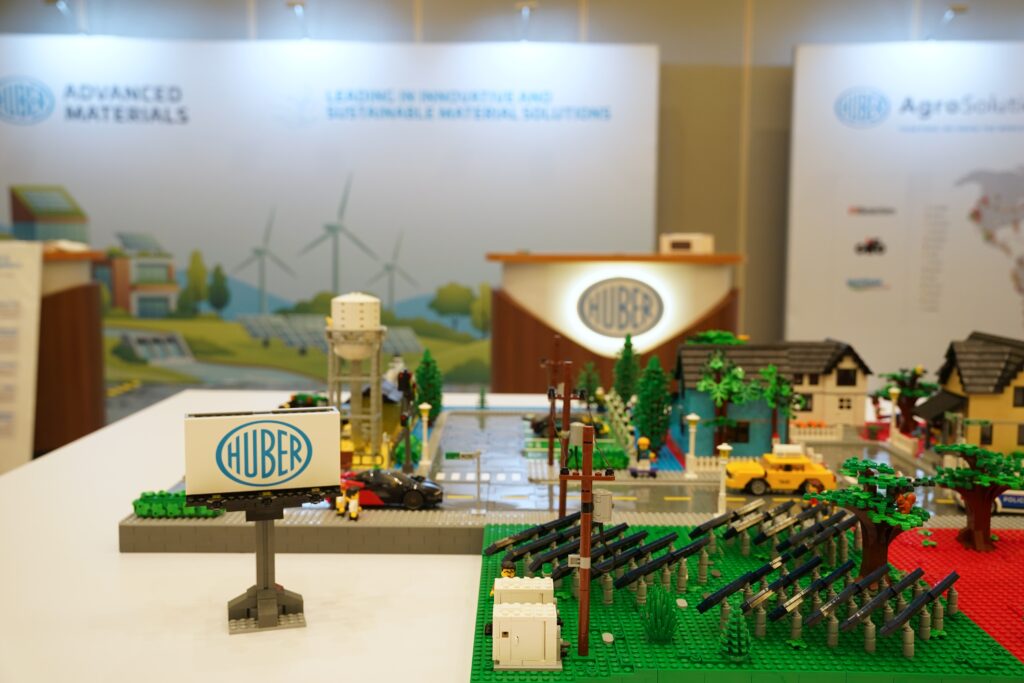
Brick Built Models built a trade show booth centerpiece for Huber Advanced Materials with exhibit house Creatacor, a 3'9" by 3'9" modular brick city running about 14,000 elements and 110 hours of design and build time, ringed by 30 gallons of bulk brick in four Huber-inspired colors. Huber chose to own the display, and that decision changed the build. It travels in custom hand-carryable wooden crates instead of cardboard, the bulk-brick stations need no vendor staff to keep running, and the centerpiece shows up again at the next event.
Interactive Means the Attendee Leaves Something Behind
The strongest test of an interactive booth activation is whether each visitor produces something the next visitor can see. While quick touchpoints like button presses, wheel spins, or photo stops provide great initial touchpoints, adding collaborative features creates layered engagement across the entire show.
What attendees report wanting is hands-on contact. Trade Show Executive, reporting on Freeman's Unpacking XLNC research into adult learning at conferences and trade shows, found that 75% of attendees say demonstrations or hands-on trials of products and solutions help them learn best.
Freeman's earlier XLNC work with IMEX, across 2,600+ attendees and organizers, found 61% of attendees define an immersive experience as "hands-on product interaction."
We’re already seeing that shift on the planning side, too. Amex GBT's 2026 Global Meetings & Events Forecast, a YouGov survey of 601 event professionals ranks "more interactive sessions, e.g. workshops" first among the ways audience expectations had shifted. Improving the attendee experience with more memorable events is their #1 priority for 2026, ahead of incorporating the latest technology. Digital photo booths, for example, sit at 15% in the same survey, second from last among nine technologies event professionals expect to use.
In other words, attendees don’t just want a flashy show.
They actually want to do something.
And more exhibitors, sponsors, and trade show vets are leaning in.
An attraction that resets between visitors hands every attendee the identical experience, so nobody has a reason to come back. One that accumulates gives the afternoon attendee a different booth from the morning's, driving return visits that can turn a passing interaction into a real conversation.
Brick Built Models designed the SAS Innovate 2026 build to be a collaboration. SAS released the instructions for its 768 sections in staged groups across the conference, which let the team control the pace, hold high-impact details back until later, and complete roughly 100 sections every two hours.
That roll-out kept the activation from becoming a one-and-done photo op, and instead made the wall feel alive. Like a project the entire event was working on together in real time.
The SAS on-site team called the response "overwhelmingly positive," noting that "people loved the activation and some got really into it, doing upwards of 20 tiles."
How to Choose the Right Activation for Your Booth
Every format on this list comes down to the same five questions, and you can answer most of them before you contact a vendor.
- Throughput against traffic: Multiply the published people-per-hour by the show’s open hours and compare the result to the visitors you expect, then check the footprint against the booth you already paid for. The list spans 10 to more than 100 people an hour, and price and novelty predict none of it.
- Staffing: Count the people the format consumes, yours or the vendor’s. The Exhibitor Advocate found 55% of exhibitors limiting on-site staff and 80% naming cost management their top challenge, so every attraction taxes the resource you have least of.
- Rent or own: Decide which budget line it hits and what it costs to ship and store for every show after this one. Freeman’s published guidance keys on frequency, renting for one or two shows and buying once your calendar carries three or more with similar configurations.
- Lead time: Count the runway from final design approval, not from your first email. Published production clocks run from 7 business days for a prize wheel to a month or more for a custom mosaic, and your event date eliminates more options than your budget does.
- What you keep: Know whether the finished piece goes home with you, goes back to the vendor, or goes onto a wall. Brick Built Models most often rents its mosaics, with purchase available when a team wants to keep the finished piece, and a centerpiece can be rented or owned.
Then apply the strongest filter.
Does the activation actually…activate attendees?
Or is it just a cute moment that’s quickly forgotten?
Combining creative booth design with active participation gives attendees a compelling reason to stay and return. Brick Built Models partners with experiential agencies and event producers to enhance their overall booth concepts—whether through a live brick mosaic where every visitor adds a piece, or a custom centerpiece surrounded by open build stations that draws traffic into the broader brand experience.
Plan Your Booth Activation
Brick Built Models is a brand experience company that builds Brick Activations™ for business buyers.
Bring your event date, your booth dimensions, and your expected floor traffic, and book a discovery call to scope a LIVE Brick Mosaic™ or a centerpiece that will generate buzz and connect you to attendees like nothing else.
Frequently Asked Questions About Interactive Booth Ideas
What Counts as an Interactive Booth?
An interactive booth is one where attendees do something with their hands and leave with a result they made. Button presses, wheel spins, code scans, and camera poses all register as participation on a lead form. None of them leave anything behind for the next attendee to see. The practical test is whether the booth looks different at 4 p.m. than it did at 10 a.m.
What are the Best Interactive Trade Show Booth Ideas for a 10-by-10 Booth?
The best interactive booth ideas for a 10-by-10 booth are a live brick mosaic like Brick Built Models' LIVE Brick Mosaics™, where attendees each build one section of a branded image across the show, and a centerpiece model with hands-on build stations, which Brick Built Models also designs and builds. Other options that work well include an AI headshot station, an instant-print photo wall, a custom prize wheel, and a rented arcade game. The first two accumulate as the day goes on, which gives attendees a reason to come back to your booth.
How Many People per Hour Can an Interactive Booth Activation Handle?
Published throughput for booth activations ranges from about 10 people an hour to more than 100, depending entirely on the format. Multiply the published rate by your show's open hours before you compare it against anything.
- Phototek NYC: 100+ AI headshots per hour.
- Danger.Live: 60 to 75 screen prints per hour per press.
- Goofy Faces: 10 to 15 black-and-white caricatures per hour.
- Fun & Games Event Hire: up to 120 players an hour for a table-top plinko board, and up to 90 for whack-a-mole.
- Brick Built Models: 100 mosaic sections every two hours at SAS Innovate, and 135 sections in 90 minutes at Victory of the Lamb.
Should You Rent or Buy an Interactive Booth Attraction?
Rent when you're exhibiting at one or two shows, testing something new, or facing overlapping show dates, and buy when your calendar carries at least three shows with similar configurations. That's Freeman's published guidance, and it keys on how often you'll use it. Mosaic walls, photo booths, headshot stations, and simulators are typically rentals, though a Brick Built Models mosaic can be purchased if you want to keep the finished piece. Prize wheels and branded kits are purchases you'll ship, store, and pay material handling on at every show.
How Far in Advance Should You Book an Interactive Booth Activation?
Book far enough ahead that the production clock still fits, and start counting from final design approval rather than from your first email. Spinning Designs publishes 7 to 20 business days for a prize wheel depending on diameter, Picture Mosaics publishes a two-to-three week development cycle for live-event mosaics, and Brick Built Models publishes 10 to 12 weeks for custom branded sets. Brick Built Models scopes mosaic runway in discovery against the event date.
What are Some Fun Interactive Booth Ideas That Don't Need Extra Staff?
Fun interactive booth ideas that spare your headcount are the ones the vendor either staffs itself or ships as a self-run kit. Extraordinary includes two attendants with its 360 booth and Phototek NYC includes one attendant with its headshot booth. A collaborative brick build wall can run without any vendor builder on site, which is how both published Brick Built Models mosaics operated, using pre-sorted color bins, instruction sheets, and remote support. Scrutinize the formats that consume your own people, including an instant-print wall, a prize wheel, and any station your team has to operate.
LEGO® is a trademark of the LEGO Group, which does not sponsor, authorize, or endorse Brick Built Models.