
Brand Activation: Your Guide to
Larger-than-Life Marketing Experiences
A brand activation is a designed, time-bound experience built to get an audience doing something with a brand rather than watching it. It runs at an event, a booth, a store, or a street corner, and it produces a countable result.
Most companies instantly jump at the idea of a brand activation. It's exciting, flashy, and newsworthy. But it's important to work with a brand activation partner that helps guide you through the process, handle the logistics, and nail the execution.
What's in a Brand Activation, Anyway?
A brand activation is a designed, time-bound experience an audience physically or actively takes part in, staged by a brand to move a specific behavior. It has a footprint, a build calendar, a crew, and a teardown.
The Marketing Accountability Standards Board defines brand activation as "marketing that builds a brand's image and drives a specific consumer behavior," and adds that it "encompasses all aspects of marketing outside of advertising."
Technically, that includes a huge variety of marketing tactics (even a coupon, a loyalty email, and an influencer post). But, practically speaking, brand activation marketing is all about the moments where your audience does something, not just receives something.
The Event ROI Institute puts the standard bluntly. "If the event does not make participants do something they would otherwise not have done, there is no value."
Experiential marketing is one discipline inside brand activation, sitting alongside promotion, retailer, relationship, content, and influencer marketing. Every experiential program is an activation, but plenty of activations fall into a different category altogether.
Brand engagement names the behavior an activation is trying to produce, which makes it a good objective and a poor format.
The terms a buyer will hear for brand activation:
- Marketing activation: the closest true synonym.
- Experiential marketing: one discipline inside activation, often used for the whole.
- Brand experience: agency-side phrasing for the same deliverable.
- Engagement marketing: more common in B2B, emphasizing participation over reach.
Eight Types of Brand Activations
Eight formats cover almost every type of brand activation. The main factors that separate different types of activation are whether something has to be built, whether the audience touches it, and what it hands back to the team afterward.
| Type | What the audience does | Where they usually appear | Results |
|---|---|---|---|
| Experiential installation | Walks into, handles, or builds something | Conferences, festivals, flagship events, lobbies | Participation counts, dwell, photos, first-party sign-ups |
| Product sampling and trial | Tries the product on the spot | Retail, festivals, campuses, transit hubs | Trials, trial-to-purchase rate, direct product feedback |
| In-store and on-site | Comes to a retail floor for a reason other than shopping | Stores, dealerships, showrooms | Foot traffic, basket size, in-store sales lift |
| Trade show and conference booth | Stops at a booth to do something | Expo halls, user conferences | Badge scans, meetings booked, qualified leads |
| Pop-up activation or installation | Visits a short-run space the brand doesn't normally occupy | Streets, vacant retail, city centers | Attendance, press coverage, email and waitlist capture |
| Sponsorship activation | Encounters a sponsor's build inside someone else's event | Sports, music, industry conferences | Reach against the host's audience, on-site participation |
| Digital and social | Submits, shares, plays, or votes on a screen | Apps, social platforms, streams | Shares, submissions, user-generated content |
| Hybrid | Takes part in a room and on a stream at the same time | Any of the above | Combined in-person and remote participation |
Installations, booths, pop-ups, and most sponsorship builds are fabrication projects with production runways measured in weeks. Sampling, digital, and social programs are staffing and platform projects, and they move much faster.
Sampling gets treated as the least sophisticated type on the list, and the measurement body disagrees. The Event Marketing Measurement Association argues that "Time Spent ≠ Impact Delivered" and that "you can deliver something meaningful in 20 seconds if it's well targeted." A sampling table that puts product in people's hands and asks one qualifying question can generate more usable first-party data than an installation costing many times more.
Digital and social activations run on the same logic at a different scale. Spotify Wrapped reached "more than 300 million engaged users and more than 630 million shares on social media globally in 56 languages," according to Spotify's earnings post.
Sponsorship activations have their own economics, because the sponsor buys access to an audience someone else assembled and then pays again to do something with it. Sponsor packages at the UK data conference SQLBits start at about $4,000, and that price buys the right to show up. The build itself costs more.
In-store and on-site activations run on footfall somebody else already paid for. The retailer supplies the audience, so the budget buys placement rather than attraction, and the numbers that come back are retail ones, foot traffic and basket size and in-store lift. Coca-Cola's Share a Coke ran the format at both ends of its life, from customization kiosks in Australian malls in 2011 to a 600-stop US tour in 2015.
Brand Activation Metrics: How to Measure the Impact of Brand Experiences
Brand activations can produce trials, first-party data, press, and conversations a media buy can't produce, because the audience is actually in the room.
Lead generation is "the No. 1 most measured data point among all event marketers," with on-site engagement second, according to the 2026 EventTrack benchmark study as reported by Event Marketer.
Other metrics often measured by brand activation campaigns:
| What to count | How it gets captured | What it tells you |
|---|---|---|
| Throughput | Staff tally, session counter, or completed units | Whether the format matched the room's pace |
| Participation rate | Participants divided by people who passed the space | The honest denominator, the way Leidos published 84 against 16,588 |
| Qualified leads | Badge scan plus one qualifying question at the station | Volume against the EMMA definition rather than raw scans |
| Meetings booked | Calendar records, before and after the show | The metric Cisco set a target against and beat by 453% |
| First-party records | Opt-in capture at the point of participation | What the activation hands the CRM the following week |
| Cost per participant | Total activation cost divided by counted participants | Comparable across formats, if you define participant once and keep it |
| Pipeline influenced | CRM attribution on everyone who entered the space | The only number a CFO reads without translation |
CEIR research published by IAEE reports that 81% of exhibitors evaluate the effectiveness of their attendee engagement activities and measurement seems to be improving overall. Bizzabo's 2026 State of Events report says 40% of organizers report difficulty proving event ROI in 2026, but it's down from 70% the year before.
Brand Activation Pricing: What a Real-World Experience Costs
Spending on activations is large and still climbing.
Global B2C and B2B experiential marketing grew 8.3% to $138.94 billion in 2025 and is forecast to rise another 10.3% in 2026, according to PQ Media's global forecast, with B2B spending at $41.74 billion and the US at $64.43 billion of the worldwide total.
Exhibitions alone generated $178.5 billion of direct spending across more than 180 countries in 2025, about $39,200 per exhibitor, per UFI's impact study produced by Oxford Economics.
Expect four figures for a rented format, five figures for a full booth program, and six figures for a flagship activation.
- Small, single-event activation: Roughly $10,000 to $30,000. A tabletop or single-station experience, minimal custom fabrication, one or two staff.
- Mid-size booth activation: Roughly $30,000 to $150,000. Custom-built centerpiece, dedicated floor space, a small on-site crew, and some pre-event promotion.
- Large-format or multi-city: $150,000 and up. Big custom builds, travel and installation, professional staffing, and a content team capturing it.
Costs to include in the model that people usually forget:
- Shipping and crating, which can run 10 to 20 percent of the build cost for large pieces
- Drayage and labor rules at the venue, which vary widely by convention center
- Install and teardown time, often billed as a separate line
- On-site staffing, including anyone you hire locally
- Storage between events if you plan to reuse the piece
- Photo and video capture, which is cheap on-site and expensive to recreate later
EXHIBITOR's budget survey puts booth space at 23% of the exhibiting dollar, show services at 18%, design and construction at 16%, and shipping and travel at 11% each.
Its rule of thumb prices the whole show at roughly three times the exhibit-space rental.
Four variables have a big effect on costs:
- City: Exhibiting in New York costs approximately 75% more than in Atlanta, per The Exhibitor Advocate's 2025 survey of 224 exhibitor manuals across 23 US cities, audited by EVOLIO.
- Weight and crating: Drayage bills round-trip by the hundredweight, "always rounded up to the next hundred," with a 200 to 300 pound minimum per shipment, and uncrated shipments "can incur 35 to 55 percent higher rates."
- Timing: Ordering late costs about 41% more on Freeman's published electrical example, and a Chicago permit multiplies twentyfold on the same paperwork.
- Staffing model: A self-run activation and a vendor-staffed one differ by the crew, the travel, and the per-diems, before anything gets built.
Renting vs Owning
Another important decision is whether you plan to rent or own the activation.
Depending on your plans and the activation type, one of these may be a cheaper or more attractive option.
Rentals "may do the trick" for a brand exhibiting at one or two shows, according to Freeman, and a schedule with "at least three shows with similar configurations" may make a custom booth "the most cost-effective choice."
Ownership costs more than the purchase price, because an owned asset has to survive freight it will pay for repeatedly. Viper Tradeshow Services' 2026 rate card nearly doubles between an Atlanta show and a Chicago one, so the show calendar sets the carrying cost of anything you keep.
Renting shortens the runway. Condit lists 6 to 8 weeks for a rental against 8 to 12 for a custom purchase, and the rush path Classic Exhibits publishes exists only on the rental side.
Brick Built Models runs its live brick mosaic activations both ways, rented for the event and sent back afterward, or purchased so the team keeps the finished piece.
Renting or owning can also change how the piece is engineered, crated, and priced, so it costs money to settle it late.
Brand Activation Examples: 13 Real-World Experiences
1. Red Bull's Stratos Mission
In October 2012, Red Bull staged what is still the reference point for spectacle in brand activation, sending Felix Baumgartner into the stratosphere in a helium balloon to break the sound barrier in freefall. YouTube reported the same day that "at peak, you were watching more than 8 million concurrent livestreams of this mission" on its official blog.
2. Share a Coke
Coca-Cola's "Share a Coke" started in Australia in 2011, with the logo replaced by the 150 most popular Australian first names and customization kiosks touring shopping malls. Coca-Cola's own history records "more than 250 million named bottles and cans sold" in a country of about 23 million people. The 2015 US run went to 1,000 names and put a physical tour on the road, customizing "more than one million" mini cans "at over 600 tour stops," according to the company's investor release. Divide one by the other and a staffed tour stop averaged about 1,700 cans.
3. Spotify Wrapped
Spotify Wrapped runs a physical layer most people never see. Spotify staged around 50 pop-up experiences in 2025, in Manchester, Seoul, Mexico City, and New York among others, per its newsroom.
4. SAS's Build-It-Together Mosaic at SAS Innovate 2026
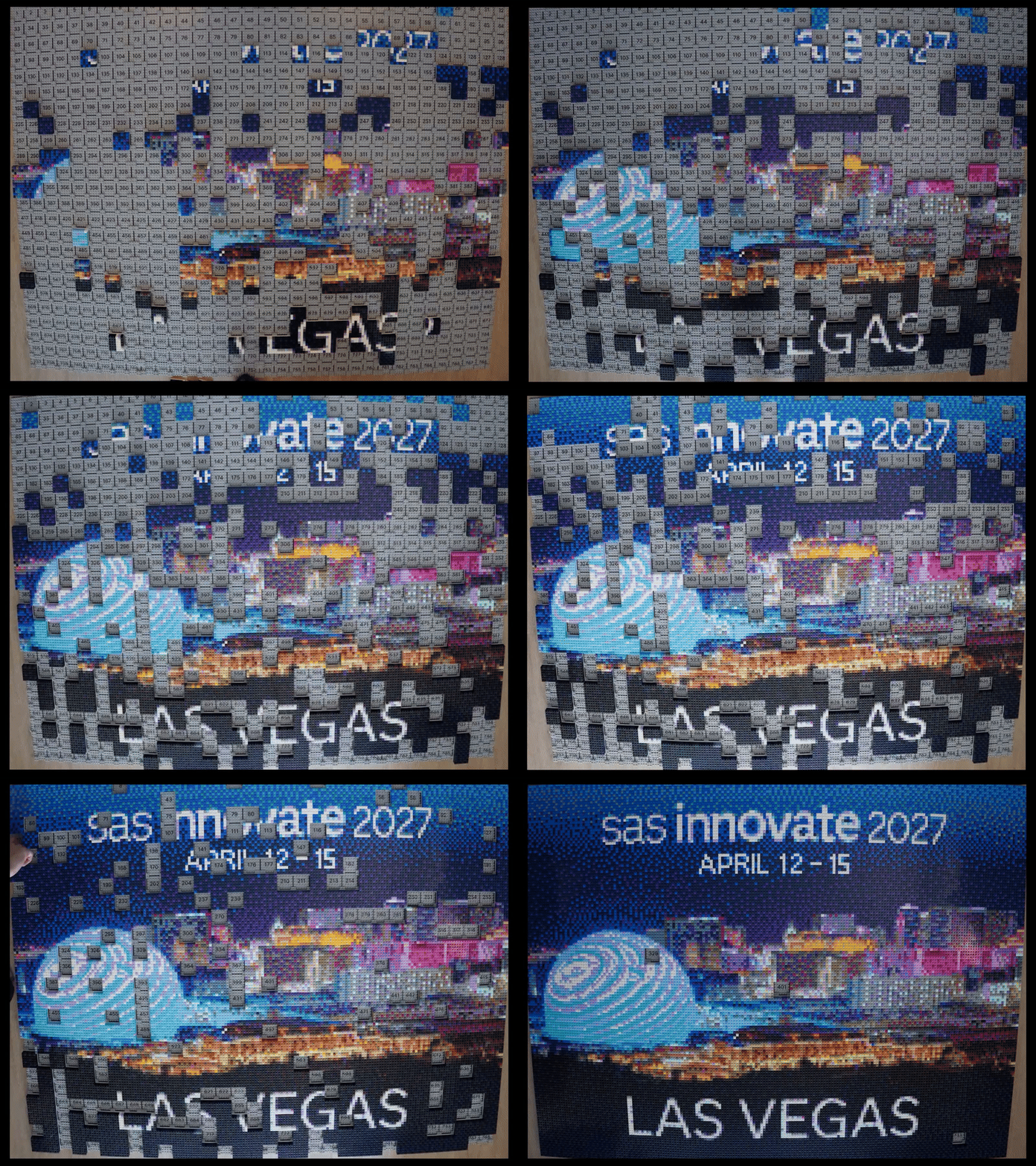
About 400 of the roughly 2,000 attendees at SAS Innovate 2026 in Grapevine, Texas, put at least one section into a 5-foot by 3.7-foot LEGO® brick mosaic over the run of the conference.
The finished picture came to 768 individual build sections and more than 27,000 bricks, assembled in five staged phases at a pace of roughly 100 sections every two hours, so the image was visibly further along each time a delegate walked back past it.
We designed the artwork and shipped the build as a kit. SAS ran it as a self-run conference activation with its own staff working from a master manual and remote support. The on-site team described the reaction as "overwhelmingly positive" and reported that "some got really into it, doing upwards of 20 tiles," and SAS scored the activation 5 out of 5 on engagement, brand alignment, and photo opportunities.
5. Snapchat Spectacles
Snapchat parked a yellow vending machine on the Venice Beach boardwalk on 10 November 2016 with no announcement. The Snapbot had a circular try-on screen, three buttons, a card swipe, and dispensed Spectacles at $129.99, and trucks "came in and refilled the box every 100 pairs or so," TechCrunch reported from the scene. A locator page then ran a 24-hour countdown to the next location, which is the guerrilla form of a pop-up activation, unannounced and deliberately hard to find. Within a day, Fortune counted about 70 sales on eBay at $500 to $2,000 apiece.
6. IKEA's Sleepeasy
IKEA's Sleepeasy ran two August weekends in SoHo in 2024, a "reimagined Swedish bodega" frontage opening into a multi-level speakeasy walkthrough built around six sleep products, with live music and food.
7. Cisco's Arcade Cabinet at Gartner IT Symposium/Xpo
Cisco ran an '80s arcade cabinet at Gartner IT Symposium/Xpo 2023 whose gaming filters made hidden network security threats visible, across a 20-by-20-foot hall stand and an 8-by-26-foot in-line booth positioned outside the C-level lounge.
The stated goal was to "score 15 on-site customer meetings." Cisco held 83, on a promotional budget in the $100,000 to $199,000 band.
8. Leidos's Hologram Booth at HIMSS 2024
Leidos put a live hologram presenter in its HIMSS 2024 booth with an AI vision system counting the audience, and published the clearest set of participation numbers in the category. Per its Sizzle entry, 16,588 people flowed through the exhibit space, 7,052 registered as unique hologram impressions, and 84 directly interacted, alongside a 221% year-over-year increase in scheduled private meetings.
9. Salesforce's Agent-Building Tables at Dreamforce 2024
Salesforce counted "more than 45,000 Trailblazers from over 140 countries" at Dreamforce 2024 in its own recap.
Event Marketer's field report supplies the operational detail Salesforce didn't publish, including Howard Street closed and rebuilt as a forest with a waterfall, nature sounds and live plants, 14,000 badges collected between 6 and 11 a.m. on day one, and more than 10,000 AI agents built on-site by attendees at long tables in the Agentforce Launch Zone.
10. Huber's Brick City at HUBERpalooza
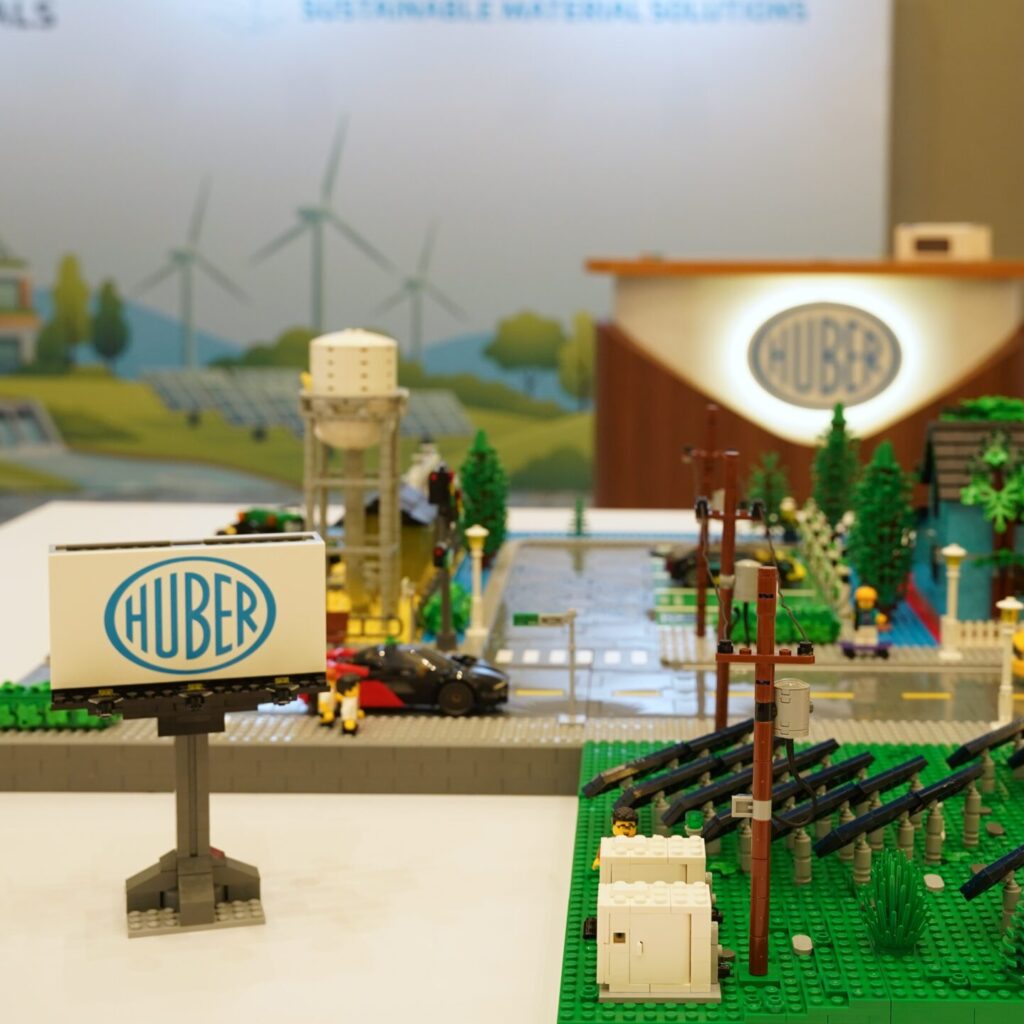
Huber Advanced Materials put a 3-foot-9-inch square modular LEGO® brick city at the center of HUBERpalooza at the Ritz-Carlton Amelia Island in June 2026, produced alongside exhibit house Creatacor.
The city runs to about 14,000 elements and took 110 hours of design and build time. Around it sat 30 gallons of loose bulk brick, 7.5 gallons to a color, so the people who stopped had something to do with their hands instead of a model to look at.
Huber decided a rented or owned display in the first conversation and chose to own it, so the brief became a build that had to be durable, transportable, and ready to come out of its boxes again. That is what put the city on modular sections and sent it traveling in hard crates a person can carry. A piece coming back to the studio the week after one event needs none of that.
No attendee count and no participation figure was published for it, by Huber or by us, which is the normal state of a company's own event. What the ownership answer did produce is a booth asset with a second and third outing in it, where the cost of showing up again is freight rather than fabrication.
11. SQLBits Turns the Whole Venue into the Activation
SQLBits re-themes its entire venue every year and matches the theme to the room. The 2024 edition took over Farnborough, the UK's first airfield, with flight simulators, themed photo props, venue-wide flight branding, and aerodynamically twisted sponsor stands, described in the organizers' own pre-event write-up. SQLBits describes its delegates as "2000 strong." It's the venue-scale idea in this set a mid-market brand could copy at its own budget.
12. Slack's Three-Hour Slackathon at Frontiers 2019
Slack ran its first Slackathon as a three-hour build competition inside Frontiers 2019, judged science-fair style, with "more than 100 people" participating "representing a cross section of industries including finance, air travel and AI," per Slack.
Capital One won. Structurally it's a live collaborative build in software. Timed, completable, hands-on, with a reveal at the end.
13. Victory of the Lamb's 90-Minute Mosaic at Mission Forward
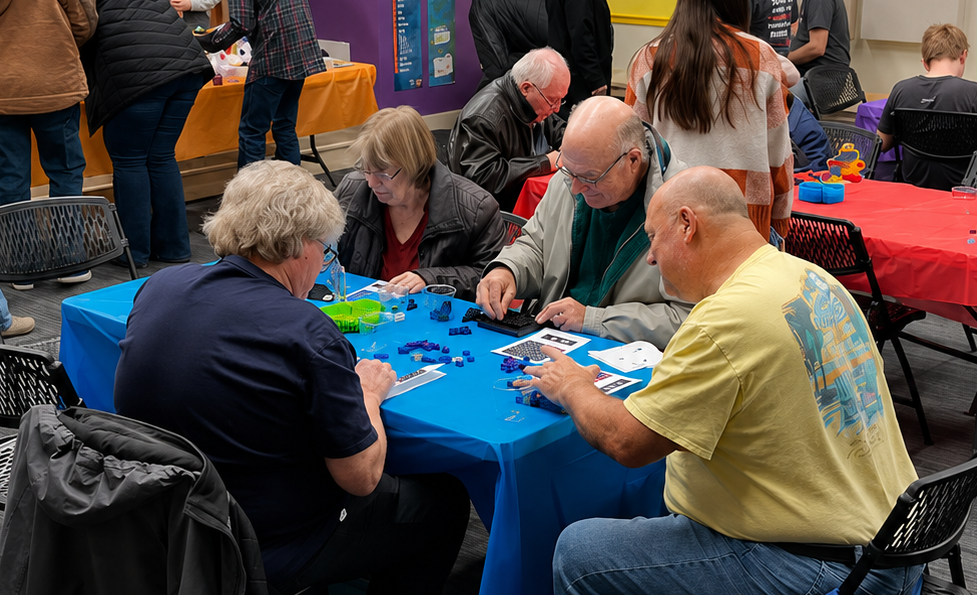
Victory of the Lamb ran a 75-inch by 45-inch mosaic of 135 build sections at its Mission Forward campaign event in February 2026, and a rotating crowd finished the whole picture inside a single 90-minute reveal window. Each person spent 2 to 5 minutes on a section and then made room for the next one.
Afterward the finished piece was mounted permanently on a French cleat.
Planning a Brand Activation: 6 Steps to Going Live
Planning an activation runs through six stages, and the calendar governs all of them. The date sets what's still buildable, the budget sorts what's left, and teams almost always work that order backwards.
Start with Behavior, Not the Concept
What do you want an attendee to physically do? Write that sentence first. Everything else follows from it.
Make the Ask Small
Ninety seconds of participation converts far better than a ten-minute experience, and a person who does the small thing will often stay for the long conversation.
Give the Sales Team a Job
An activation that runs itself is a missed opportunity. The build should create a natural pause where a rep can start talking.
Design for a Photo
If there's no moment worth capturing, you lose the reach that justifies the spend.
Plan the Second Life
Decide before the show where the finished piece goes. A customer office, your lobby, a charity, or a follow-up gift to a top account.
Book Early
Custom fabrication, freight, and show floor rules all have deadlines that arrive earlier than people expect.
Production Timelines by Activation Type
Estimated production timelines by activation type, as published by the vendors that build them. Organizer and venue deadlines for approvals, services, and permits stack on top of these.
| Activation type | Estimated timeline |
|---|---|
| Branded build-your-own kits | 10–12 weeks |
| Custom-built exhibit, purchased | 8–12 weeks |
| Rental exhibit | 6–8 weeks, reserved 12–16 weeks out |
| Brick mosaic build | 6+ weeks |
| Custom prize wheel | 2–4 weeks |
| Live photo mosaic | 2–3 weeks |
| Rush rental exhibit, graphics ready | 1–2 weeks |
For the largest shows the runway is measured in quarters. IMTS publishes a six-phase exhibitor workbook running from September 2025 to December 2026, about 16 months end to end.
Brand Activation Mistakes to Avoid
Procedure stops more brand activations than bad creative does.
The Booth Gets Staffed with the Wrong People
Haon, Sego, Drapeau and Sarin studied 9,215 attendees and 885 exhibitors in Industrial Marketing Management and found that "relative to attendee preferences, exhibitors significantly understaff with technical personnel, while overstaffing with executive/upper management and sales/marketing personnel."
An interactive format can make this worse, because the person running the activity is the person answering the product question.
The Invoice Doesn't Match the Quote
Writing in EXHIBITOR, a practitioner with 25 years in the field estimates that "about 50 percent of the show invoices I've received had at least one error on them," including one that came in almost $20,000 above expectation.
The same publication warns that even when an exhibit house calls a project turnkey, the term "usually doesn't mean that the price includes service fees from other providers," such as riggers and caterers.
Leads Never Get Followed Up
Robyn Davis of Exhibitors WINH told Trade Show Executive that "just because someone's excited to talk with you doesn't mean they're a hot lead," and that for follow-up "the biggest challenge is typically bandwidth." Sarah Gannon, Director of Corporate Events at MathWorks, told the same publication that "we have to partner with our sales teams to make sure that those hot leads that were identified are followed up with."
A Participation Format People Start and Can't Finish
Norton, Mochon and Ariely's study of the IKEA effect in the Journal of Consumer Psychology had people bid on things they had assembled, and found that builders who finished bid $1.46 against $0.59 from builders who were stopped partway.
Their conclusion was that "labor leads to love only when labor results in successful completion of tasks." It's a lab bidding task rather than a booth, but the design lesson carries. A participation format people start and can't finish is worse than no format, and it's the one failure here the activation designer controls.
How Brick Built Models Builds Brand Engagement
Brick Built Models is a brand experience company, and the live build mosaics and statement pieces are our signature formats.
What clients hire us for is the experience. A crowd spends the show building something with your brand at the center of it, photographs it without being asked, and talks about it in the aisles. What's left afterward is a finished piece that hangs in your office and a stack of photos your team didn't have to stage.
We design the experience around your event, your audience, and your objective, then run it with our crew on the floor or self-run by your team with our kit and manual. You can rent the activation for the event or keep the finished piece.
We start by helping customers answer the critical questions:
- What does someone physically do at this activation?
- Can they understand the invitation from ten feet away with no help?
- What do they learn about our company by doing it?
- How does a participant become a known contact?
- What number will we report afterward, and what's the target?
- Where does this thing live after the event?
Activations reward specificity. The broad ones get traffic and teach nobody anything. The specific ones get fewer people, keep them longer, and put something on your team's calendar the following week.
Start with what you want the visitor to remember. Build backward from there.
Plan Your Activation Today
Planning an event where you want people doing more than watching?
Let's explore an interactive brand experience built around your audience, your goals, and the specific event you'll be attending.
We'll discuss your business needs and help you find the right solution for your timeline, budget, and objectives.
Frequently Asked Questions About Brand Activation
What Is Brand Activation?
Brand activation is marketing that gets an audience to do something with a brand rather than watch it. MASB, the Marketing Accountability Standards Board, defines it as "marketing that builds a brand's image and drives a specific consumer behavior" and notes that it "encompasses all aspects of marketing outside of advertising." In event and experiential practice the term usually means something narrower, a designed, time-bound experience with a footprint, a build calendar, and a crew, running at a trade show, a conference, a store, a festival, or a public space.
What Are Examples of Brand Activation?
Well-known consumer activations include Red Bull Stratos, Coca-Cola's Share a Coke tour, Spotify Wrapped's pop-ups, Snapchat's Spectacles vending machines, IKEA's Sleepeasy, and Refinery29's 29Rooms. Documented B2B examples include Cisco's arcade cabinet at Gartner IT Symposium/Xpo, Leidos's hologram booth at HIMSS, Salesforce's agent-building tables at Dreamforce, and Slack's Slackathon at Frontiers. Participation builds from Brick Built Models run at both scales. Attendees at SAS Innovate 2026 assembled a 768-section brick mosaic over the course of the conference, and Victory of the Lamb's crowd finished a 135-section mosaic in a single 90-minute window.
How Much Does a Brand Activation Cost?
Expect four figures for a rented format, five figures for a full booth program, and six figures for a flagship activation. Published format prices start at $1,100 for a digital mosaic wall and run to $2,000 to $8,000 per event for a photo mosaic wall. EXHIBITOR prices a whole show at roughly three times the exhibit space rental, with design and construction taking 16% of the exhibiting budget, so a $30,000 space buy implies about a $90,000 show. At the top of the published record, Cisco reported a $100,000 to $199,000 promotional budget for its award-winning Gartner activation. City, shipping weight, and how late you book move the number more than the creative does.
How Far Ahead Do You Have to Book a Brand Activation?
Between about two weeks and roughly seven months, depending on the format and the venue. Branded build-your-own kits run 10 to 12 weeks, fully custom exhibits 8 to 12 weeks, and rental exhibits 6 to 8 weeks with reservations 12 to 16 weeks out, while mosaic builds come together in 2 to 4 weeks. The venue runs its own clock on top of production, since design approvals, fire-marshal blueprints, and advance service rates all close weeks before the doors open, and major shows take space applications about seven months ahead. Work backwards from the show's own deadline sheet rather than forwards from a production estimate.
What's the Difference Between Brand Activation and Experiential Marketing?
Experiential marketing is one discipline inside brand activation, which makes the two overlapping rather than equivalent. In everyday use most people treat the terms as interchangeable, and an activation with a physical build and live participation is correctly described either way.
LEGO® is a trademark of the LEGO Group, which does not sponsor, authorize, or endorse Brick Built Models.